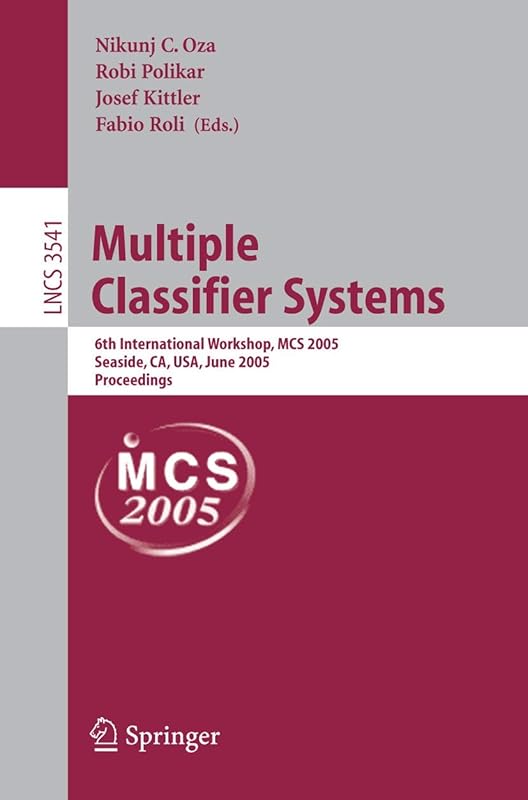
Multiple Classifier Systems: 6th International Workshop, MCS 2005, Seaside, CA, USA, June 13-15, 2005, Proceedings (Lecture Notes in Computer Science, 3541) by Nikunj C. Oza

Multiple Classifier Systems: 6th International Workshop, MCS 2005, Seaside, CA, USA, June 13-15, 2005, Proceedings (Lecture Notes in Computer Science, 3541)

Nikunj C. Oza
444 pages
Springer
Jun 2005
Paperback
Computers & Internet WSBN
0
Readers
0
Reviews
0
Discussions
0
Quotes
The belief that a committee of people make better decisions than any individual is widely held and appreciated. We also understand that, for this to be true, the members of the committee have to be simultaneously competent and comp- mentary. This intuitive notion holds true for committees of data sources (such as sensors) and models (such as classi?ers) . The substantial current research in the areas of data fusion and model fusion focuses on ensuring that the di?- ent sources provide useful information but nevertheless complement one another to yield better results than any source would on its own. During the 1990s, a variety of schemes in classi?er fusion, which is the focus of this workshop, were developed under many names in di?erent scienti?c communities such as machine learning, pattern recognition, neural networks, and statistics. The previous ?ve workshops on Multiple Classi?er Systems (MCS) were themselves exercises in information fusion, with the goal of bringing the di?erent scienti?c commu- ties together, providing each other with di?erent perspectives on this fascinating topic, and aiding cross-fertilization of ideas. These ?ve workshops achieved this goal, demonstrating signi?cant advances in the theory, algorithms, and appli- tions of multiple classi?er systems. Followingits?vepredecessorspublishedbySpringer, thisvolumecontainsthe proceedings of the 6th International Workshop on Multiple Classi?er Systems (MCS2005) heldattheEmbassySuitesinSeaside, California, USA, June13-15, 2005. Forty-two papers were selected by the Scienti?c Committee, and they were organized into the following sessions: Boosting, Combination Methods, Design of Ensembles, Performance Analysis, and Applications.
Join the conversation

No discussions yet. Join BookLovers to start a discussion about this book!

No reviews yet. Join BookLovers to write the first review!

No quotes shared yet. Join BookLovers to share your favorite quotes!

Earn Points
Your voice matters. Every comment, review, and quote earns you reward points redeemable for Bitcoin.
Comment +5 pts Review +20 pts Quote +7 pts Upvote +1 pt
BookMatch Quiz
Find books similar to this one
About this book
Pages 444
Publisher Springer
Published 2005
Readers 0