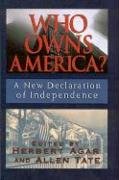
Who Owns America? A New Declaration of Independence is the classic sequel to I'll Take My Stand, the famous defense of the South's agrarian traditions. But whereas I'll Take My Stand was theoretical and sectional, Who Owns America? sought to be concrete and national, and it succeeded. The book evokes and defends in realist terms an America characterized by small-property ownership, decentralized politics, and responsible stewardship of the nation's natural resources.
It was a radical statement in 1936 and remains one at the end of the twentieth century. How should a republic exercise power over its citizens? How may economic goods be justly distributed? What status should the small farm have in the life of a nation? By what means may family life be rendered stable? What is the economic role of women in a free society? These are just some of the issues raised, and answered in unique ways, in this book. Though written over sixty years ago, Who Owns America? still challenges many assumptions at play in the American public psyche and is also indispensable in understanding a crucial period of American history. Read more Continue reading Read less FROM THE INSIDE FLAP
Who Owns America? A New Declaration of Independence is the classic sequel to I'll Take My Stand, the famous defense of the South's agrarian traditions. But whereas I'll Take My Stand was theoretical and sectional, Who Owns America? sought to be concrete and national, and it succeeded. The book evokes and defends in realist terms an America characterized by small-property ownership, decentralized politics, and responsible stewardship of the nation's natural resources. In 1936, the year Who Owns America? was published, reform was in the air in America. Plans to pull the country out of the devastation of the Great Depression, including Roosevelt's New Deal, abounded. But, as co-editor Herbert Agar wrote, "No country can be reformed by the people who hate it. The haters can supply useful criticism. But only those who have affection for the national ideal can persuade a people to reform." What was the national ideal, according to regionalist and decentralist writers like Allen Tate, Herbert Agar, John Crowe Ransom, Mary Shattuck Fisher, Cleanth Brooks, and Hilaire Belloc? Their answer was simple. The ideal was nothing other than the original American Dream: the majority of men should be politically and economically independent, not the dependents of either big government or big business. It was a radical statement in 1936 and remains one at the end of the twentieth century. How should a republic exercise power over its citizens? How may economic goods be justly distributed? What status should the small farm have in the life of a nation? By what means may family life be rendered stable? What is the economic role of women in a free society? These are just some of the issues raised, and answered in unique ways, in this book. Though written over sixty years ago, Who Owns America? still challenges many assumptions at play in the American public psyche and is also indispensable in understanding a crucial period of American history. As Edward S. Shapiro observes in his important and substantial new Foreword to this volume, "The urgency of the questions posed by Who Owns America? has not changed since 1936, nor has the answer. The political events of the last two decades have demonstrated the relationship between political freedom and prosperity on the one hand and the widespread distribution of property and economic and political decentralization on the other. Critics during the 1930s derided the contributors to Who Owns America? as romantics, visionaries, and utopians. In fact, the collectivists, with their faith for a better world through industrial giantism and economic and political planning, were the true utopians." FROM THE BACK COVER
"The essays in Who Owns America? not only elaborate and clarify the critique of industrialism, corporate capitalism, and the bureaucratic state put forth in I'll Take My Stand, but defend the widespread ownership of property as the foundation for individual liberty and the morally responsible life. Professor Shapiro's fine introduction positions the book within the political, social, and economic debates of the 1930s and demonstrates its relevance to current efforts to restore private property or find its equivalent."-Mark Malvasi, author, The Unregenerate South "Who Owns America? is one of the forgotten classics of American political protest. Its power to provoke is undiminished, for Who Owns America? is a book inspired by an ideal. Its neo-Jeffersonian vision of a decentralized America-a land of small property ownership and an independent citizenry-continues to shape conservative discourse on the nature of good society. Now back in print, with an incisive Foreword by Edward Shapiro, this spirited volume invites a fresh and careful reading."-George H. Nash, author, The Conservative Intellectual Movement in America Since 1945 ABOUT THE AUTHOR
Herbert Agar (1897-1980) was a columnist for the Louisville Courier-Dispatch from 1935 to 1939. Winner of the Pulitzer Prize in History in 1936, Agar wrote The People's Choice: From Washington to Harding: A Study in Democracy (1933) , Land of the Free (1935) , Pursuit of Happiness: The Story of American Democracy (1938) , and The Price of Union (1950) . Allen Tate (1899-1979) was a Southern Agrarian and a notable poet and man of letters. Best known for his poem "Ode to the Confederate Dead" and his novel The Fathers, Tate wrote biographies of Stonewall Jackson and Jefferson Davis and several volumes of literary criticism. His Essays of Four Decades is also published by ISI Books. Read more Continue reading Read less