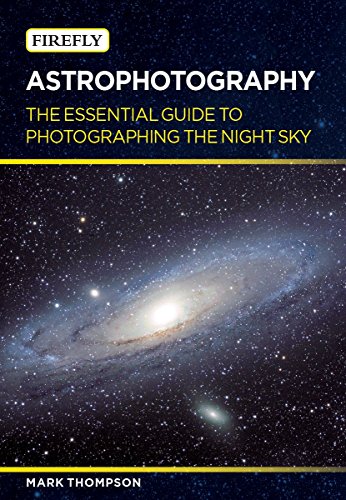
Astrophotography: The Essential Guide to Photographing the Night Sky by Mark Thompson

Astrophotography: The Essential Guide to Photographing the Night Sky

Mark Thompson
160 pages
Firefly Books
Nov 2015
Outdoors & Nature WSBN
0
Readers
0
Reviews
0
Discussions
0
Quotes
<p> Today's amateur and professional astronomers take images of the stars using affordable digital cameras known as CCD (charge coupled devices) . This improved technology has made astrophotography possible for everyone; however CCD cameras have features exclusive to astronomy and so there is a learning curve. </p><p> <i>Astrophotography: The Essential Guide to Photographing the Night Sky</i> features practical guidance from an astrophotographer with years of experience explaining astronomy to hobbyists. Mark Thompson, known as &quot;the people's astronomer&quot; in the UK, guides readers through the entire process, beginning with buying equipment and ending with processing images on a home computer using free software. From the humble mobile phone to high-end specialist cameras, Thompson brings it all to life with his experiences, and many of his own astronomical images. The book includes: Choosing the right equipment: Digital SLR cameras and lenses, guide camera, webcams, tripods, telescopes (reflecting and refracting, tracker imaging) and mounts (altazimuth, equatorial, fork, drive camera) , dew protection and heaters, color filter wheels, solar filters, electronic focuser. Getting images without a telescope: The &quot;300&quot; rule, ISO speed noise reduction, exposure times, star trails, constellations, Space Station and satellite photography, meteor showers, auroras, noctilucent clouds, combined exposures, &quot;live view&quot;, the Sun, eclipses. Solar System photography: Smartphones, webcams, using free RegiStax software, infrared blocking filters. Deep-Sky Images: Balancing a telescope, polar alignment, connecting camera to telescope, setting up guide cameras, camera cooling technology, focus, image calibration, fat fields and dark frames, image composition, true color, mosaic images. Astronomical Image Processing: Calibration, linear and log scaling, adjusting curves, combining images, processing filters, combining LRGB (Luminance, Red, Green and Blue) , narrowband processing, one-shot color images, advanced techniques A Typical Imaging Run: Following the author step by step, equipment storage, start-up procedures. </p><p> Fully illustrated and clearly presented, <i>Astrophotography: The Essential Guide to Photographing the Night Sky</i> puts great astronomical images within the reach of even the most novice stargazer. </p>
Join the conversation

No discussions yet. Join BookLovers to start a discussion about this book!

No reviews yet. Join BookLovers to write the first review!

No quotes shared yet. Join BookLovers to share your favorite quotes!

Earn Points
Your voice matters. Every comment, review, and quote earns you reward points redeemable for Bitcoin.
Comment +5 pts Review +20 pts Quote +7 pts Upvote +1 pt
BookMatch Quiz
Find books similar to this one
About this book
Pages 160
Publisher Firefly Books
Published 2015
Readers 0