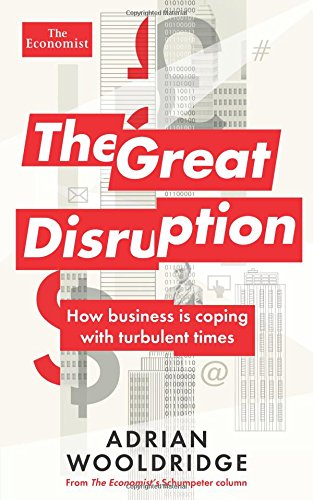
The Great Disruption: How business is coping with turbulent times by The Economist 


       			,

The Great Disruption: How business is coping with turbulent times

The Economist ,
295 pages
PublicAffairs, 2015.
Jun 2015
Business & Investing WSBN
1
Readers
0
Reviews
0
Discussions
0
Quotes
<i>The Great Disruption</i> is a collection drawn from Adrian Wooldridge's influential Schumpeter columns in <i>The Economist</i> addressing the causes and profound consequences of the unprecedented disruption of business over the past five years.<br><br>The Great Disruption has many causes. The internet is spreading faster than any previous technology. Emerging markets are challenging the west's dominance of innovation as well as manufacturing. Clever management techniques such as &quot;frugal innovation&quot; are forcing companies to rethink pricing. Robots are advancing from the factory floor into the service sector. But these developments are all combining together to shake business life - and indeed life in general - to its foundations.<br><br>The Great Disruption is producing a new class of winners, many of whom are still unfamiliar: Asian has more female billionaires and CEOs than Europe, for example. It is also producing a growing class of losers: old-fashioned universities that want to continue to operate in the world of talk and chalk; companies that refuse to acknowledge that competition is now at warp speed; and business people who think that we still live in the world of company man. It is forcing everybody to adapt or die: workers realise that they will have to jump from job to job - and indeed from career to career - and institutions realise that they need to remain adaptable and flexible.<br><br>The Great Disruption is all the more testing because it coincides with the Great Stagnation. The financial crisis has not only reduced most people's living standards in the west. It has also revealed that the boom years of 2000-20007 were built on credit: individuals and governments were borrowing money to pay for lifestyles that no longer had any real justification. Employees are having to cope with unprecedented change at a time when they are also seeing their incomes flat or declining. Companies are having to respond to revolutionary innovations even as they are seeing their overall markets contract. We are all having to run faster in order to stay in the same place.<br><br>This book begins with a long introduction explaining the thesis of the book and setting it in a broad historical context. It will also introduce readers to Joseph Schumpeter and explain why his ideas about creative destruction are particularly valuable today.<br>
Join the conversation

No discussions yet. Join BookLovers to start a discussion about this book!

No reviews yet. Join BookLovers to write the first review!

No quotes shared yet. Join BookLovers to share your favorite quotes!

Earn Points
Your voice matters. Every comment, review, and quote earns you reward points redeemable for Bitcoin.
Comment +5 pts Review +20 pts Quote +7 pts Upvote +1 pt
BookMatch Quiz
Find books similar to this one
About this book
Pages 295
Publisher PublicAffairs, 2015.
Published 2015
Readers 1