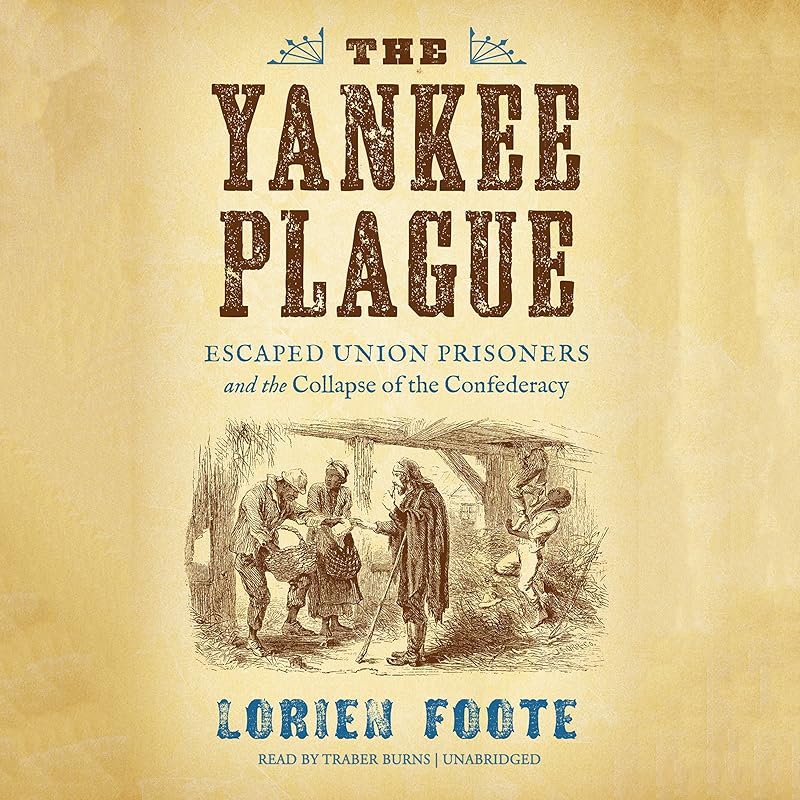
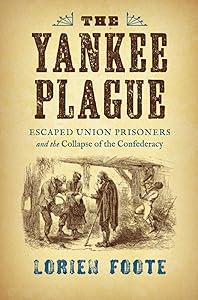
The Yankee Plague: Escaped Union Prisoners and the Collapse of the Confederacy
Lorien Foote
A rare and insightful account of the thousands of Union soldiers who escaped Confederate imprisonment and aided in the final dissolution of the Confederacy.
During the winter of 1864, more than 3,000 Federal prisoners of war escaped from Confederate prison camps into South Carolina and North Carolina, often with the aid of local slaves. Their flight created, in the words of contemporary observers, a "Yankee plague", heralding a grim end to the Confederate cause. In this fascinating look at Union soldiers' flights for freedom in the last months of the Civil War, Lorien Foote reveals new connections between the collapse of the Confederate prison system, the large-scale escape of Union soldiers, and the full unraveling of the Confederate States of America. By this point in the war, the Confederacy was reeling from prison overpopulation, a crumbling military, violence from internal enemies, and slavery's breakdown. The fugitive Federals moving across the countryside in mass numbers, Foote argues, accelerated the collapse as slaves and deserters decided the presence of these men presented an opportune moment for escalated resistance.
Blending rich analysis with an engaging narrative, Foote uses these ragged Union escapees as a lens with which to assess the dying Confederate States, providing a new window into the South's ultimate defeat.
Read more REVIEW
Packs a very powerful scholarly punch. . . . Definitely merits award consideration and will likely earn a spot on many of this year's 'Best Of' lists.--Civil War Books and Authors
Foote's work is a significant achievement in that it introduces a new dimension to discussions of the Civil War.--The Journal of Southern History
The rare title that delivers new information and challenges readers to reconsider what they are confident they already know."-Indiana Magazine of History
One of the most intriguing books on Civil War captivity in years.--The Register of the Kentucky Historical Society
This is a prime example of the very best of current Civil War History. By applying the analytical power of social history and razor-sharp military and political analysis, Foote constructs a new paradigm for understanding the war in which the most potent invading armies run away from the enemy, slaves hold the key to freedom, and women are the most domineering commanders.--Journal of American History
Foote delivers a story rich in style and powerful in substance. With insight and alacrity, the author delivers a powerful perspective on how the 'Yankee Plague' of escaped prisoners became an integral part of a process that contributed to the disintegration and demise of the Confederacy. There are few books that combine well-written, easy-to-read prose with groundbreaking historical insights and perspectives. This is one of them.--American Historical Review
The Yankee Plague makes for an important addition to the literature on Civil War prisoners and the collapse of the Confederacy.--Civil War Monitor
A fascinating examination of one of the under-studied effects of a collapsing war effort, namely, the inability to hold, guard, and maintain enemy prisoners of war (POWs) . A brilliant examination of a complex subject.--Journal of Military History
Anyone interested in the Carolinas during the war, prisoners of war, or the war on the Southern home front will not regret adding this book to their library.--Journal of America's Military Past
An illuminating and powerful study that enhances both Civil War history and POW studies. Essential.--Choice
REVIEW
This is one of the most original, intriguing, and satisfying books I have read in years. Superbly researched and interpreted, Lorien Foote has added layers of complexity to our understanding of the chaotic Confederate home front and the last gasps of rebel resistance.--Daniel E. Sutherland, author of A Savage Conflict: The Decisive Role of Guerrillas in the American Civil War ABOUT THE AUTHOR
Lorien Foote is a professor of history at Texas A&M University, with a specialty in the American Civil War and Reconstruction. She is the author of Seeking the One Great Remedy as well as The Gentlemen and the Roughs, which was a finalist for the 2011 Gilder Lehrman Lincoln Prize.
Traber Burns worked for thirty-five years in regional theater, including the New York, Oregon, and Alabama Shakespeare festivals. He also spent five years in Los Angeles appearing in many television productions and commercials, including Lost, Close to Home, Without a Trace, Boston Legal, Grey's Anatomy, Cold Case, Gilmore Girls, and others.
Read more