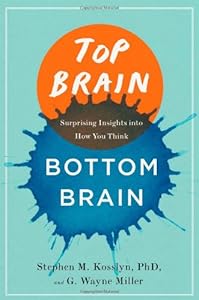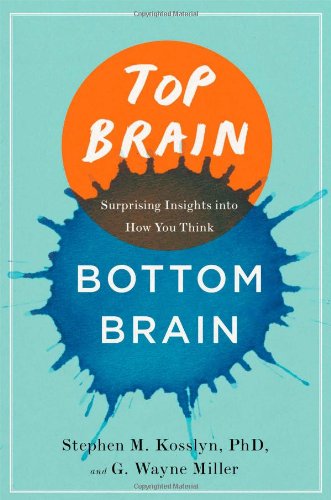
Top Brain, Bottom Brain: Surprising Insights into How You Think by G. Wayne Miller

Top Brain, Bottom Brain: Surprising Insights into How You Think

G. Wayne Miller
222 pages
Simon & Schuster
Mar 2015
Science WSBN
3
Readers
1
Reviews
0
Discussions
0
Quotes
One of the world's leading neuroscientists teams up with an accomplished writer to debunk the popular left-brain/right-brain theory and offer an exciting new way of thinking about our minds. The second edition, with expanded practical applications, highlights how readers can harness the theory to succeed in their own lives.<br><br>For the past fifty years, popular culture has led us to believe in the left-brain vs. right-brain theory of personality types. Right-brain people, we've been told, are artistic, intuitive, and thoughtful, while left-brain people tend to be more analytical, logical, and objective. It would be an illuminating theory if it did not have one major drawback: It is simply not supported by science.<br> <br>Dr. Stephen M. Kosslyn, who Steven Pinker calls &quot;one of the world's great cognitive neuroscientists,&quot; explains with cowriter G. Wayne Miller an exciting new theory of the brain. Presenting extensive research in an inviting and accessible way, Kosslyn and Miller describe how the human brain uses patterns of thought that can be identified and understood through four modes of thinking: Mover, Perceiver, Stimulator, and Adaptor. These ways of thinking and behaving shape your personality, and with the scientifically developed test provided in the book, you'll quickly be able to determine which mode best defines your own usual style. Once you've identified your usual mode of thought, the practical applications are limitless, from how you work with others when you conduct business, to your personal relationships, to your voyage of self-discovery.
Join the conversation

No discussions yet. Join BookLovers to start a discussion about this book!

A new way of thinking about thinking

We have a rough sense that people have different stable personalities that cross situations to some extent. We also tend to think of people learning and even reasoning differently from each other. But so far these perceptions have not really lent themselves to good scientific models using clear categories. We have popular models of personality, some better validated than others, and we have popular stereotypes, but none of them specifically and scientifically addresses broad cross-domain patterns in the way we think. So it is of great significance that we are starting to see such a model introduced in this book. This is based on both neurobiological and psychological concepts and empirical work and is rooted in a realistic model of how our thinking involves both ongoing interaction with our environments and planned metacognitive control and all sorts of combinations of those. We've needed a new way of envisioning human thinking styles for a while and this is the most original and carefully executed attempt I've seen in a long time. Read more

No quotes shared yet. Join BookLovers to share your favorite quotes!

Earn Points
Your voice matters. Every comment, review, and quote earns you reward points redeemable for Bitcoin.
Comment +5 pts Review +20 pts Quote +7 pts Upvote +1 pt
BookMatch Quiz
Find books similar to this one
About this book
Pages 222
Publisher Simon & Schuster
Published 2015
Readers 3