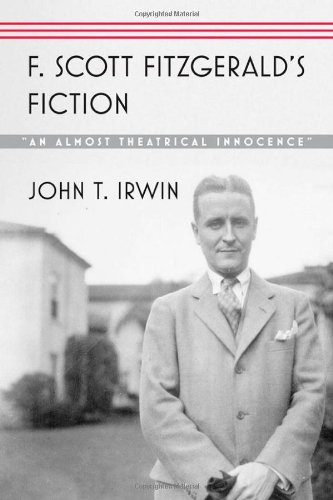
F. Scott Fitzgerald's Fiction: "An Almost Theatrical Innocence" by John T Irwin

F. Scott Fitzgerald's Fiction: "An Almost Theatrical Innocence"

John T Irwin
233 pages
Johns Hopkins University Press
Feb 2014
All Non-Fiction WSBN
4
Readers
1
Reviews
0
Discussions
0
Quotes
<p>&quot;Fitzgerald's work has always deeply moved me,&quot; writes John T. Irwin. &quot;And this is as true now as it was fifty years ago when I first picked up <i>The Great Gatsby</i>. I can still remember the occasions when I first read each of his novels; remember the time, place, and mood of those early readings, as well as the way each work seemed to speak to something going on in my life at that moment. Because the things that interested Fitzgerald were the things that interested me and because there seemed to be so many similarities in our backgrounds, his work always possessed for me a special, personal authority; it became a form of wisdom, a way of knowing the world, its types, its classes, its individuals.&quot;</p><p>In his personal tribute to Fitzgerald's novels and short stories, Irwin offers an intricate vision of one of the most important writers in the American canon. The third in Irwin's trilogy of works on American writers, <i>F. Scott Fitzgerald's Fiction</i> resonates back through all of his previous writings, both scholarly and poetic, returning to Fitzgerald's ongoing theme of the twentieth-century American protagonist's conflict between his work and his personal life. This conflict is played out against the typically American imaginative activity of self-creation, an activity that involves a degree of theatrical ability on the protagonist's part as he must first enact the role imagined for himself, which is to say, the self he means to invent. </p><p>The work is suffused with elements of both Fitzgerald's and Irwin's biographies, and Irwin's immense erudition is on display throughout. Irwin seamlessly ties together details from Fitzgerald's life with elements from his entire body of work and considers central themes connected to wealth, class, work, love, jazz, acceptance, family, disillusionment, and life as theatrical performance.</p>
Join the conversation

No discussions yet. Join BookLovers to start a discussion about this book!

this has surprising grammatical errors

As students, professors require us to avoid sentence fragments like plague. In the concluding statement in his preface to this book, however, this author writes as follows: "All of which ultimately goes to say, as you no doubt suspect, that what follows is a labor of love." If that is not a sentence fragment, I don't know what is. Would it not require an act of faith for a reader who comes across this egregious grammatical error to get any further into this book? I did and read further through page 2 and came across this one: "Not only a son but a grandson as well to bear his name and be the custodian of his story, the living vessel of memory." One question is: Why's it ok for a professor to habitually write sentence fragments in a book published with a major university press, but not so for students to do the same in essays for their course grades? Read more

No quotes shared yet. Join BookLovers to share your favorite quotes!

Earn Points
Your voice matters. Every comment, review, and quote earns you reward points redeemable for Bitcoin.
Comment +5 pts Review +20 pts Quote +7 pts Upvote +1 pt
BookMatch Quiz
Find books similar to this one
About this book
Pages 233
Publisher Johns Hopkins Univer...
Published 2014
Readers 4