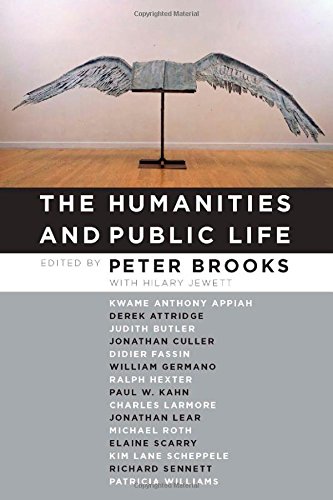
The Humanities and Public Life by Peter Brooks

The Humanities and Public Life

Peter Brooks
164 pages
Fordham University Press
Mar 2014
Professional & Technical WSBN
0
Readers
0
Reviews
0
Discussions
0
Quotes
Is there an ethics of reading, and is this something that the interpretive humanities can and should contribute to other professional fields, including law, and to public life?<br><br>This book tests the proposition that the humanities can, and at their best do, represent a commitment to ethical reading. And that this commitment, and the training and discipline of close reading that underlie it, represent something that the humanities need to bring to other fields: to professional training and to public life.<br><br>What leverage does reading, of the attentive sort practiced in the interpretive humanities, give you on life? Does such reading represent or produce an ethics? The question was posed for many in the humanities by the &quot;Torture Memos&quot; released by the Justice Department a few years ago, presenting arguments that justified the use of torture by the U.S. government with the most twisted, ingenious, perverse, and unethical interpretation of legal texts. No one trained in the rigorous analysis of poetry could possibly engage in such bad-faith interpretation without professional conscience intervening to say: This is not possible.<br><br>Teaching the humanities appears to many to be an increasingly disempowered profession--and status--within American culture. Yet training in the ability to read critically the messages with which society, politics, and culture bombard us may be more necessary than ever in a world in which the manipulation of minds and hearts<br>is more and more what running the world is all about.<br><br>This volume brings together a group of distinguished scholars and intellectuals to debate the public role and importance of the humanities. Their exchange suggests that Shelley was not wrong to insist that poets are the unacknowledged legislators of mankind: Cultural change carries everything in its wake. The attentive interpretive reading practiced in the humanities ought to be an export commodity to other fields and to take its place in the public sphere.in the public sphere.
Join the conversation

No discussions yet. Join BookLovers to start a discussion about this book!

No reviews yet. Join BookLovers to write the first review!

No quotes shared yet. Join BookLovers to share your favorite quotes!

Earn Points
Your voice matters. Every comment, review, and quote earns you reward points redeemable for Bitcoin.
Comment +5 pts Review +20 pts Quote +7 pts Upvote +1 pt
BookMatch Quiz
Find books similar to this one
About this book
Pages 164
Publisher Fordham University P...
Published 2014
Readers 0