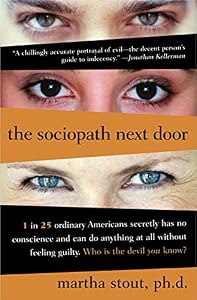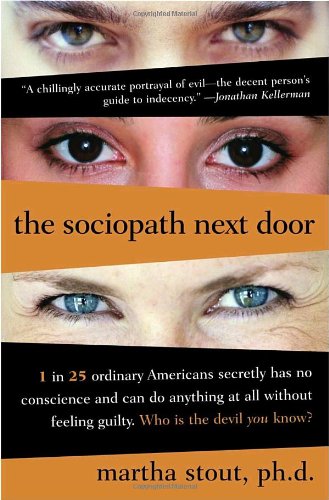
The Sociopath Next Door by Martha Stout

The Sociopath Next Door

Martha Stout
241 pages
Broadway Books
Feb 2005
Hardcover
Psychology & Philosophy WSBN
3
Readers
1
Reviews
0
Discussions
0
Quotes
<p>Who is the devil <i>you</i> know? <br><br>Is it your lying, cheating ex-husband?<br>Your sadistic high school gym teacher?<br>Your boss who loves to humiliate people in meetings?<br>The colleague who stole your idea and passed it off as her own?<br><br>In the pages of <i>The Sociopath Next Door</i>, you will realize that your ex was not just misunderstood. He's a sociopath. And your boss, teacher, and colleague? They may be sociopaths too.<br><br>We are accustomed to think of sociopaths as violent criminals, but in <i>The Sociopath Next Door</i>, Harvard psychologist Martha Stout reveals that a shocking 4 percent of ordinary people - one in twenty-five - has an often undetected mental disorder, the chief symptom of which is that that person possesses no conscience. He or she has no ability whatsoever to feel shame, guilt, or remorse. One in twenty-five everyday Americans, therefore, is secretly a sociopath. They could be your colleague, your neighbor, even family. And they can do literally anything at all and feel absolutely no guilt. <i><br></i><br>How do we recognize the remorseless? One of their chief characteristics is a kind of glow or charisma that makes sociopaths more charming or interesting than the other people around them. They're more spontaneous, more intense, more complex, or even sexier than everyone else, making them tricky to identify and leaving us easily seduced. Fundamentally, sociopaths are different because they cannot love. Sociopaths learn early on to show sham emotion, but underneath they are indifferent to others' suffering. They live to dominate and thrill to win. <br><br>The fact is, we all almost certainly know at least one or more sociopaths already. Part of the urgency in reading <i>The Sociopath Next Door</i> is the moment when we suddenly recognize that someone we know - someone we worked for, or were involved with, or voted for - is a sociopath. But what do we do with that knowledge? To arm us against the sociopath, Dr. Stout teaches us to question authority, suspect flattery, and beware the pity play. Above all, she writes, when a sociopath is beckoning, do not join the game. <br><br>It is the ruthless versus the rest of us, and <i>The Sociopath Next Door</i> will show you how to recognize and defeat the devil you know.</p>
Join the conversation

No discussions yet. Join BookLovers to start a discussion about this book!

Exceptional insight into consciousness.

Though it is written in easily understandible forms of "speech", this will continue as probably the most significant litterary work on consciousness and psychological insight into the human condition in the context of group evolution, achievement and survival. Even though the main focus is on sociopathy, it presents a field of diamonds in raising topics relating to impact and importance of psychological expression. The value of this well researched and referenced work is not so much in what is written but in the way it covers an immence field and presents an executive view of thought provoking meaning, even to the importance of genetic survival of sociopathy. It offers objective and very balanced perspectives and as such is of value to lay persons keenly persuing an understanding of the meaning of values or diminished forms thereof to individuals and communities, as well as clinical practitioners that should allways have a quick reference to the big picture plus the bonus of a reference to significant formal studies, research and perspectives on clinical development. Seldom will one see a work so comprehensive in pointers without the fluff and yet so enjoyable to read again and again. Read more

No quotes shared yet. Join BookLovers to share your favorite quotes!

Earn Points
Your voice matters. Every comment, review, and quote earns you reward points redeemable for Bitcoin.
Comment +5 pts Review +20 pts Quote +7 pts Upvote +1 pt
BookMatch Quiz
Find books similar to this one
About this book
Pages 241
Publisher Broadway Books
Published 2005
Readers 3