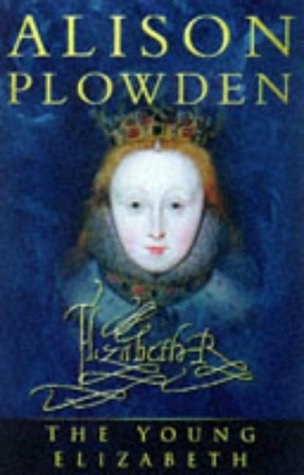
Young Elizabeth: The First Twenty-Five Years
Alison Plowden
From Library Journal This revised first volume of Plowden's highly praised Elizabethan quartet covers the first 25 years of the life of England's Virgin Queen. Given the extraordinary drama of Elizabeth's reign, readers may be forgiven for imagining that Princess Elizabeth's childhood and youth could not be as interesting as her later years as queen. But as Plowden makes clear, the young princess, who grew up knowing that her beloved father had had her mother executed, needed all her intelligence and courage just to survive long enough to claim the throne. One day a princess, the next a bastard, Elizabeth grew up amongst associates whose foolish plots endangered her and enemies who openly wished for her death, all of which makes for a thoroughly engrossing read. Moviegoers unhappy about the many inaccuracies in the recent film Elizabeth can rest assured that this is a well-researched biography. A strong addition to academic and public libraries; recommended even for libraries that have purchased other recent titles (e.g., Alison Weir's The Life of Elizabeth I, LJ 7/98) about Elizabeth. Given the recent revival of interest in the era, this is certainly a reasonable purchase.AElizabeth Mary Mellett, Brookline P.L., MA Copyright 1999 Reed Business Information, Inc. From Kirkus Reviews A lucid, well-researched, but unpedantic narrative of 16th-century English royal life and death at a brutal time when a successful noble was one who kept his or her head while others were losing theirs during perennial struggles for power and position. Biographer Plowden (The Young Victoria, 1981, etc.) relates the oft-told story of Henry VIII and his search for a male heir. His union with Catherine of Aragon produced only Mary. The frustrated Henry had his first marriage declared ``null and void'' and married Anne Boleyn, who gave birth to Elizabeth. After the troublesome Anne was beheaded, he married Jane Seymour, who did have a short-lived male heir, Edward VI. To continue his matrimonial marathon after Seymour's natural death, Henry married and divorced Anne of Cleves, followed by Catherine Howard, whom he beheaded, and then married Catherine Parr, all without a living male heir. Henry broke with the Roman Church, thereby forging a divided England. After his death, his devout Catholic daughter, Mary, became queen and an enemy of Protestants. Plowden portrays the teenage Elizabeth as a threat to Mary, who kept the former a prisoner in the Tower of London but was unable to find hard evidence of treason before the Privy Council Court. Elizabeth became a heroine of the Protestants and a popular figure. Plowden's assessment of the 25-year- old Elizabeth, who became queen after Marys death: sharp tongued and a hard bargainer with acting ability but also with hysterical tendencies perhaps inherited from her mother. From her father she inherited physical energy, family pride, vanity, personal magnetism, political instincts, and earthy peasant cunning, thanks to her Tudor Welsh ancestors. She was an apt scholar who learned discretion, self-discipline, and self-reliance, and the author suggests she used her femininity to disarm critics. Plowden proves that history can be fascinating, readable, and entertaining. --