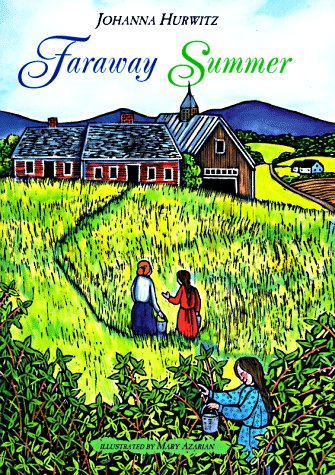

Faraway Summer by Johanna Hurwitz

Faraway Summer

Johanna Hurwitz
155 pages
Morrow Junior Books
Apr 1998
Hardcover
All Children WSBN
1
Readers
0
Reviews
0
Discussions
0
Quotes
From Publishers Weekly The 120-year-old Fresh Air Fund, which gives free rural vacations to inner-city children, here provides readers the chance to explore not one but two period settings. In the summer of 1910, 12-year-old Hadassah (Dossi) Rabinowitz, born in Russia and now orphaned, leaves the small room she and her sister share on New York City's Lower East Side to spend two weeks with a Vermont farm family. She brings the blank book she has won for "best achievement" in her seventh-grade class, and her entries comprise the narrative. Hurwitz (author of the Class Clown books) does not attempt to ape a 12-year-old's writingAthe chapters are replete with dialogue and traditional exposition. The Meades have never met a Jewish person before but are open-minded. One daughter likes Dossi immediately; the other, standoffish at first, eventually becomes a good friend. The story line is somewhat artificially pumped up around a brand-new library book that gets ruined; although there is also a fire (in which Dossi plays a heroine's part), the chief interest lies in the conscientious presentation of two different cultures. Dossi reports excitedly on Mrs. Meade's canning and the girls' farm chores; she in turn tells the Meade sisters about the pickle barrels on Delancey Street and her sister's long days at the Triangle Shirtwaist Factory. Hurwitz's research is convincing and her protagonist sympathetic enough to forgive the author's few contrivances; readers will likely be drawn to this little-known slice of history. Ages 7-up. Copyright 1998 Reed Business Information, Inc. From School Library Journal Grade 4-6AIn 1910, a 12-year-old Jewish girl from New York's Lower East Side spends two weeks with a Vermont family through the Fresh Air Fund. Dossi, short for Hadassah, lives in a tenement room with her older sister and knows only the sights and smells of her crowded community. She takes two library books with her on the long train journey to help dispel her fears, but finds that her sponsors are warm and sharing people. Each experience on the Meades' farm is new for Dossi: the size of cows, the wonder of fireflies in the night, and the quantity of food on the table. There are mild cultural differences. The Vermonters have never seen a Jew and Dossi, although non-observant, will not eat pork or mix meat and milk products. Still, she becomes friends with the two girls in the family and helps to save a neighbor's livestock when a barn catches fire. Told through Dossi's journal entries, this pleasant story is sometimes marred by stilted conversation. However, it has a happy ending and the added interest of an actual historical person, Wilson Alwyn Bentley, who first photographed snowflakes.ASusan Pine, New York Public LibraryCopyright 1998 Reed Business Information, Inc.
Join the conversation

No discussions yet. Join BookLovers to start a discussion about this book!

No reviews yet. Join BookLovers to write the first review!

No quotes shared yet. Join BookLovers to share your favorite quotes!

Earn Points
Your voice matters. Every comment, review, and quote earns you reward points redeemable for Bitcoin.
Comment +5 pts Review +20 pts Quote +7 pts Upvote +1 pt
BookMatch Quiz
Find books similar to this one
About this book
Pages 155
Publisher Morrow Junior Books
Published 1998
Readers 1