The Lying Stones of Marrakech: Penultimate Reflections in Natural History by Stephen Jay Gould

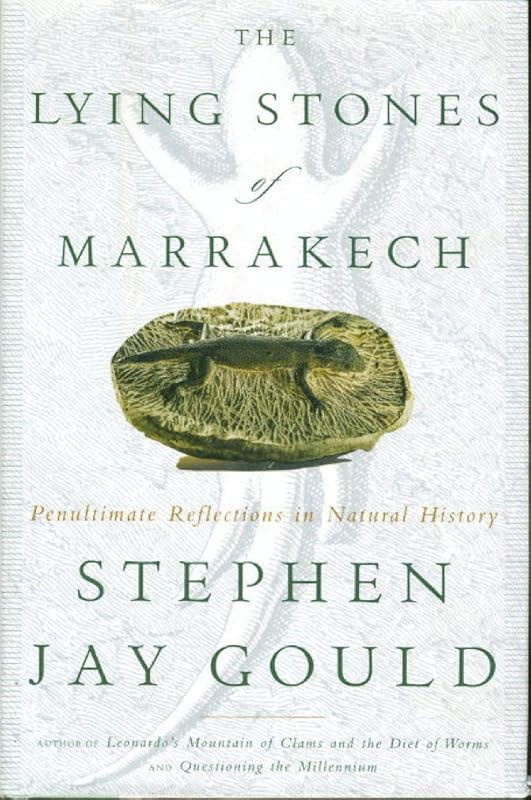
The Lying Stones of Marrakech: Penultimate Reflections in Natural History

Stephen Jay Gould
384 pages
Harmony
Apr 2000
Hardcover
Outdoors & Nature WSBN
3
Readers
1
Reviews
0
Discussions
0
Quotes
In his ninth collection of essays, bestselling scientist Stephen Jay Gould once again offers his unmistakable perspective on natural history and the people who have tried to make sense of it. In tandem with the closing of the millennium, Gould is planning to bring down the curtain on his nearly thirty-year stint as a monthly essayist for Natural History magazine. This, then, is the next-to-last essay collection from one of the most acclaimed and widely read scientists of our time. In twenty-three essays, Gould presents the richness and fascination of the various lives that have fueled the enterprise of science and opened our eyes to a world of unexpected wonders.Part I treats the most absorbing period in Gould's own subject, paleontology--the premodern struggle (from the sixteenth to the early eighteenth century) to understand the origin of fossils while nascent science grappled with the deepest of all questions about the nature of both causality and reality. Are fossils the remains of ancient organisms on an old earth, or manifestations of a stable and universal order, symbolically expressed by correspondences among nature's three kingdoms---animal, mineral, and vegetable?Part II discusses the greatest conjunction of a time, a subject, and an assemblage of amazing people in the history of natural history: the late-eighteenth to the early-nineteenth century in France, when a group that included some of the most exceptional intellects of the millennium--Georges Buffon, Antoine Lavoisier, and Jean-Baptiste Lamarck--invented the scientific study of natural history in an age of revolution.Part III illustrates the greatest British challenge to this continental preeminence: the remarkable, and wonderfully literate, leading lights of Victorian science in Darwin's age of turmoil and reassessment: Lyell's uniformitarianism, Darwin's own intellectual development, Richard Owen's invention of dinosaurs, and Alfred Russel Wallace on Victorian certainties and subsequent unpredictabilities.The last three parts of the book do not invoke biography so explicitly, but they use the same device of embodying an abstraction within a particular that can be addressed in sufficient detail and immediate focus to fit within an essay. The interlude of Part IV presents some experiments in the different literary form of short takes. Part V, on scientific subjects with more obvious and explicit social consequences (and often unacknowledged social origins as well) , also uses biography, but in a different way, to link past stories with present realities--to convey the lesson that claims for objectivity based on pure discovery often replay episodes buried in history, and prove that our modern certainties flounder within the same complexities of social context and mental blockage. Finally, Part VI abandons biography for another device of essayists: major themes (about evolution's different expression across scales of size and time) cast into the epitome of odd and intriguing particulars.
Join the conversation

No discussions yet. Join BookLovers to start a discussion about this book!

Always amazingly entertaining

Stephen Gould's essays are for me, treasures. His choice of topics are fascinating, his logic impeccable and I have a greater and greater appreciation for the scientific method after each essay read. I am just thankful for the kindle dictionary to get me through each page, though after reading many of his essays, his more regularly used words are beginning to sink in Read more

No quotes shared yet. Join BookLovers to share your favorite quotes!

Earn Points
Your voice matters. Every comment, review, and quote earns you reward points redeemable for Bitcoin.
Comment +5 pts Review +20 pts Quote +7 pts Upvote +1 pt
BookMatch Quiz
Find books similar to this one
About this book
Pages 384
Publisher Harmony
Published 2000
Readers 3