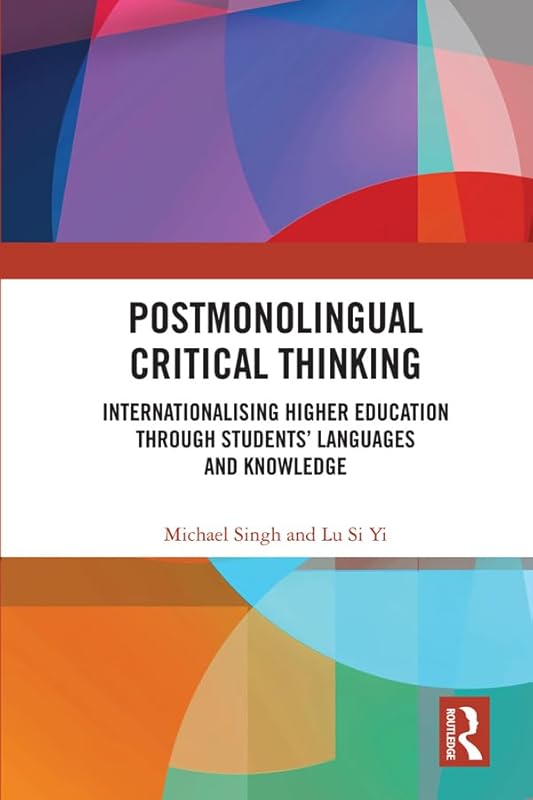
Postmonolingual Critical Thinking: Internationalising Higher Education Through Students’ Languages and Knowledge by Michael Singh

Postmonolingual Critical Thinking: Internationalising Higher Education Through Students’ Languages and Knowledge

Michael Singh
214 pages
Routledge
Apr 2020
Hardcover
History WSBN
0
Readers
0
Reviews
0
Discussions
0
Quotes
Maintaining English as the sole language of knowledge production and dissemination in universities that enrol students who speak multiple languages, and those students learning other languages, is questionable. This groundbreaking work calls into question the exclusive use of academic English in internationalising higher education teaching and research. By interrogating the dominant assumptions informing the monolingual mindset, Postmonolingual Critical Thinking indicates that academically literate students can capably use their repertoires of languages and knowledge for educational purposes. The case for students' languages and knowledge having a place in English-medium universities is made through evidence of the uses of Zhōngwén, academic Chinese.Proposing to broaden the scope of languages used for knowledge production and dissemination, this book highlights the educational potential of multilingualism. Postmonolingual Critical Thinking makes a unique proposal: that universities which recruit doctoral students from Asia create education policy practices that enable them to extend their multilingual capabilities. Arguing that by drawing on intellectual resources from their various languages, students construct knowledge of critical thinking in complex, interesting and potentially innovative ways, this book guides higher education institutions in putting this into practice. It outlines a pragmatic approach for universities to explore the potential of multipolar, multilingual education, while being attentive to the tensions posed by assertions of a monolingual mindset. Postmonolingual Critical Thinking has the potential to create great change in a higher education sector which is mired by a monolingual approach to graduate training. This unique and thought-provoking book is essential reading for those in the fields of applied linguistics, comparative education, higher education, international studies, teacher education and translation studies.
Join the conversation

No discussions yet. Join BookLovers to start a discussion about this book!

No reviews yet. Join BookLovers to write the first review!

No quotes shared yet. Join BookLovers to share your favorite quotes!

Earn Points
Your voice matters. Every comment, review, and quote earns you reward points redeemable for Bitcoin.
Comment +5 pts Review +20 pts Quote +7 pts Upvote +1 pt
BookMatch Quiz
Find books similar to this one
About this book
Pages 214
Publisher Routledge
Published 2020
Readers 0