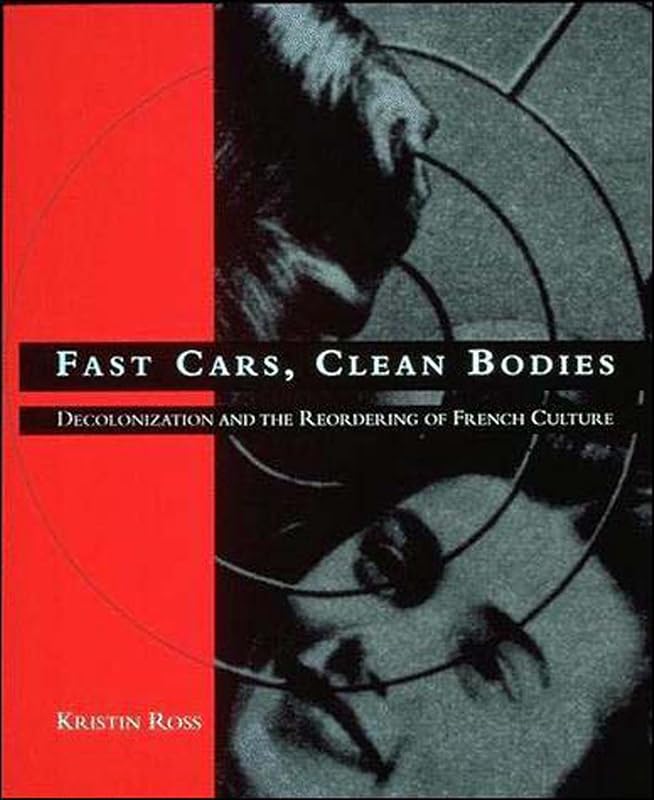
Fast Cars, Clean Bodies: Decolonization and the Reordering of French Culture (October Books) by Kristin Ross

Fast Cars, Clean Bodies: Decolonization and the Reordering of French Culture (October Books)

Kristin Ross
274 pages
The MIT Press
Feb 1996
First Edition
History WSBN
0
Readers
0
Reviews
0
Discussions
0
Quotes

Free account. We’ll keep this book ready while you join.

Find a copy

Formats and availability vary by store. As an Amazon Associate I earn from qualifying purchases.

Fast Cars, Clean Bodies examines the crucial decade from Dien Bien Phu to the mid-1960s when France shifted rapidly from an agrarian, insular, and empire-oriented society to a decolonized, Americanized, and fully industrial one. In this analysis of a startling cultural transformation Kristin Ross finds the contradictions of the period embedded in its various commodities and cultural artifacts - automobiles, washing machines, women's magazines, film, popular fiction, even structuralism - as well as in the practices that shape, determine, and delimit their uses.In each of the book's four chapters, a central object of mythical image is refracted across a range of discursive and material spaces: social and private, textual and cinematic, national and international. The automobile, the new cult of cleanliness in the capital and the colonies, the waning of Sartre and de Beauvoir as the couple of national attention, and the emergence of reshaped, functionalist masculinities (revolutionary, corporate, and structural) become the key elements in this prehistory of postmodernism in France.Modernization ideology, Ross argues, offered the promise of limitless, even timeless, development. By situating the rise of "end of history" ideologies within the context of France's transition into mass culture and consumption, Ross returns the touted timelessness of modernization to history. She shows how the realist fiction and film of the period, as well as the work of social theorists such as Barthes, Lefebvre, and Morin who began at the time to conceptualize "everyday life," laid bare the disruptions and the social costs of events. And she argues that the logic of the racism prevalent in France today, focused on the figure of the immigrant worker, is itself the outcome of the French state's embrace of capitalist modernization ideology in the 1950s and 1960s.
Join the conversation

No discussions yet. Join BookLovers to start a discussion about this book!

No reviews yet. Join BookLovers to write the first review!

No quotes shared yet. Join BookLovers to share your favorite quotes!

Earn Points
Your voice matters. Every comment, review, and quote earns you reward points redeemable for Bitcoin.
Comment +5 pts Review +20 pts Quote +7 pts Upvote +1 pt
Similar Books
Find books similar to this one
About this book
Pages 274
Publisher The MIT Press
Published 1996
Readers 0