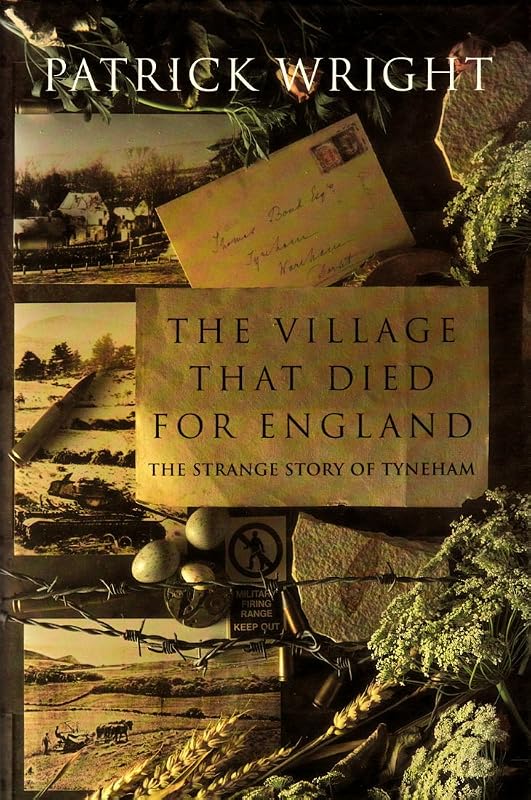

The Village That Died for England: The Strange Story of Tyneham by Patrick Wright

The Village That Died for England: The Strange Story of Tyneham

Patrick Wright
420 pages
Jonathan Cape
Jan 1995
Hardcover
History WSBN
0
Readers
0
Reviews
0
Discussions
0
Quotes

Free account. We’ll keep this book ready while you join.

Find a copy

Formats and availability vary by store. As an Amazon Associate I earn from qualifying purchases.

This is a book about the stories that lie hidden in the folds of an English landscape. Tyneham is the archetypal lost village: a Dorset hamlet evacuated for the sake of the Royal Armoured Corps tanks during ww II, and never returned to its inhabitants despite Churchill's pledge of restitution. It has lurked in the national imagination ever since, as a place of mythic rural innocence violated by the modern world: a symbol of a vanished England, a Thomas Hardy scene blasted by cannon. As film set or as the focus of campaigns for its restoration, Tyneham has become an enduring lost cause. Wright does much more than tell the strange, comic, but also moving story of this village and its afterlife. That in itself is a tale in which the villagers and their former landlords are brought vividly to life, and it evokes a mysterious stretch of coastline that has drawn mystics and artists for over a century. As it describes the dramatic collision between tanks and the landscape of Old England, the book also traces out the broader history of conservation and its place in national imagination. We visit a world of almost-forgotten idealists and utopians who tried to bring their dreams to earth. They include Rolf Gardiner, founder of an English Youth Movement unjustly accused of Nazi associations; Captain George Pitt Rivers, an openly fascist landlord intimate with Oswald Mosley and William Joyce; H.J. Massingham, the steadfast defender of rural England; Llewelyn Powys, the neglected novelist and sage haunted by Bronze Age settlements; and Sylvia Townsend Warner, who dreamed of rural class struggle in the 1930s Dorset... The book is also, in a sense, the first cultural history of English conservation. It is a superb work of excavation: of the wonderful particulars passed over by the gaze of conventional history; and of aspects of recent British experience that still have the power to disturb us as they rise to the surface.
Join the conversation

No discussions yet. Join BookLovers to start a discussion about this book!

No reviews yet. Join BookLovers to write the first review!

No quotes shared yet. Join BookLovers to share your favorite quotes!

Earn Points
Your voice matters. Every comment, review, and quote earns you reward points redeemable for Bitcoin.
Comment +5 pts Review +20 pts Quote +7 pts Upvote +1 pt
Similar Books
Find books similar to this one
About this book
Pages 420
Publisher Jonathan Cape
Published 1995
Readers 0