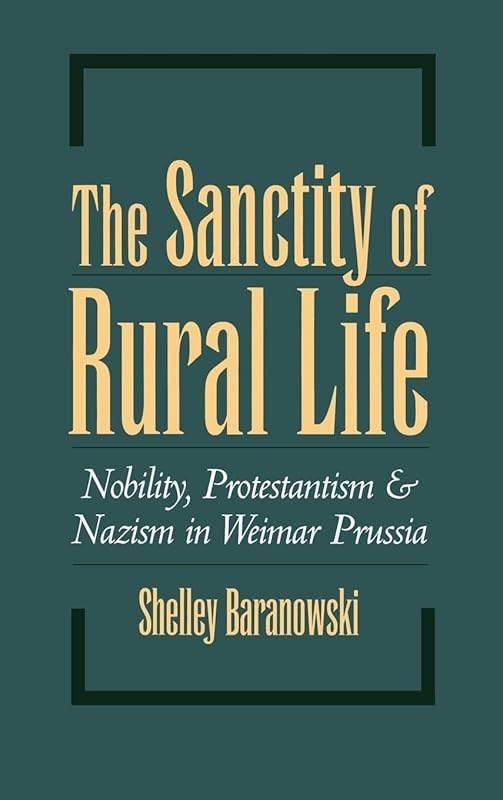
The Sanctity of Rural Life: Nobility, Protestantism, and Nazism in Weimar Prussia by Shelley Baranowski

The Sanctity of Rural Life: Nobility, Protestantism, and Nazism in Weimar Prussia

Shelley Baranowski
280 pages
Oxford University Press
Apr 1995
Hardcover
Foreign Languages WSBN
0
Readers
0
Reviews
0
Discussions
0
Quotes
In this ground-breaking study, Shelley Baranowski not only explores how and why church-going Protestants in eastern Prussia turned to Nazism in large numbers, but also shows that the rural elite and the church propagated a myth of the stability, the wholesomeness, and the class-harmony--in short, the "sanctity"--of rural life, a myth that was a key component of Nazi propaganda that helped secure support for the Third Reich in rural areas. Of great interest to historians and students of the period as well as anyone interested in how a fringe radical movement gained wide popular support. Read more Continue reading Read less REVIEW
"This exemplary study of politics and society in rural Pomerania on the eve of the Nazi takeover makes a significant contribution to our understanding of the complex and symbiotic relationship between traditional Prussian conservatism and National Socialism."--German Studies Review"Well-crafted....The book is based on extensive research in archives in Germany, Poland, and in church collections in the US, and it also reflects familiarity with the latest scholarship on Weimar Germany."--CHOICE"...A valuable contribution to German social history in the twentieth century."--American Historical Review"Baranowski's persuasive depiction of the Junkers' anti-Weimar mentality and machinations will prove indipensable to future research."--Central European History"This book is a major contribution to German social history."--HISTORY FROM THE BACK COVER
In The Sanctity of Rural Life: Nobility, Protestantism, and Nazism in Weimar Prussia, Shelley Baranowski explores how and why the rural population of eastern Prussia turned to Nazism in large numbers. She explains the role of the rural elite and the church in propagating a myth of the stability, the wholesomeness, and the class-harmony - in short, the "sanctity" - of rural life that encouraged the spread of Nazism. This study identifies the contributions of the rural elite in the eastern Prussian provinces, namely Junker landlords and the Protestant clergy, to the rise of National Socialism in a region where the rural electorate's attraction to the Hitler movement became critical to the Nazi takeover in 1933. Using the province of Pomerania as a primary example, Baranowski argues that rather than emerging strictly as a protest against the domination of elites, as is regularly suggested, the Nazis had to address issues that rural elites defined in order to establish a foothold among rural voters. The most significant issue was the conviction that the urban bias of the Weimar Republic threatened the survival of the rural economy and culture. Despite the social tensions that surfaced periodically, the anti-republicanism which united all rural classes encouraged rural dwellers to turn to Nazism as the salvation of rural society. This ground-breaking work makes a major contribution to our understanding of Protestant and rural support for Nazism and adds an important cultural and religious dimension to our understanding of the underpinnings of Nazi power. It will be of interest to historians and students of modern European and German history. ABOUT THE AUTHOR
Shelly Baranowski is Associate Professor of History at the University of Akron. Read more Continue reading Read less
Join the conversation

No discussions yet. Join BookLovers to start a discussion about this book!

No reviews yet. Join BookLovers to write the first review!

No quotes shared yet. Join BookLovers to share your favorite quotes!

Earn Points
Your voice matters. Every comment, review, and quote earns you reward points redeemable for Bitcoin.
Comment +5 pts Review +20 pts Quote +7 pts Upvote +1 pt
BookMatch Quiz
Find books similar to this one
About this book
Pages 280
Publisher Oxford University Pr...
Published 1995
Readers 0