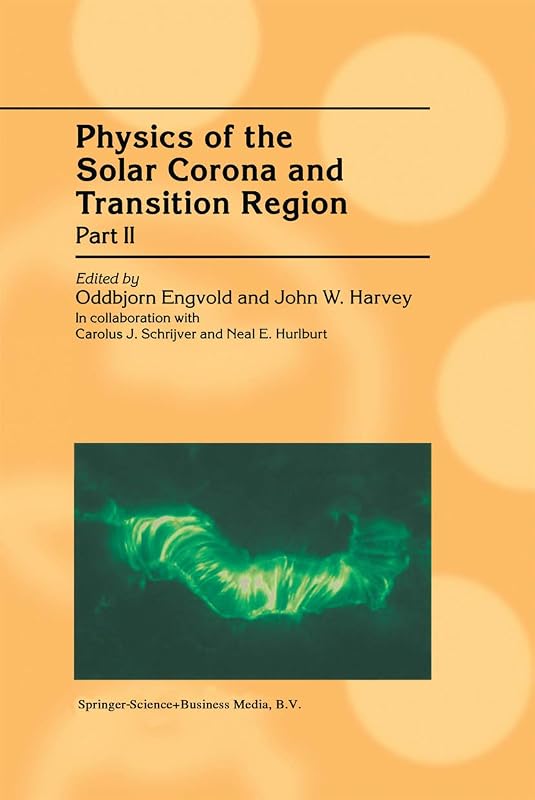
Physics of the Solar Corona and Transition Region: Part II Proceedings of the Monterey Workshop, held in Monterey, California, August 1999 by Oddbjorn Engvold

Physics of the Solar Corona and Transition Region: Part II Proceedings of the Monterey Workshop, held in Monterey, California, August 1999

Oddbjorn Engvold
671 pages
Springer
Dec 2012
Hardcover
Science WSBN
0
Readers
0
Reviews
0
Discussions
0
Quotes

Free account. We’ll keep this book ready while you join.

Find a copy

Formats and availability vary by store. As an Amazon Associate I earn from qualifying purchases.

Solar Physics publishes up to two TopicalIssues per year that focus on areas of especially vigorousand activeresearch. The present TopicalIssue containspapers of recent results on the solar corona, as well as on the transition region and low solar wind. The majority of these papers, which were all refereed in accordance withthe standards of Solar Physics, werepresentedin August 1999at a workshop heldin Monterey, California. TheSun's magneticfieldis responsibleforthe spectacularly dynamicand intri­ cate phenomenonthat we call the corona. The past decade has seen an enormous increase in our understanding of this part of the solar outer atmosphere, both as a result of observations and because of rapid advances in numerical studies.The Yohkoh satellitehasobservedthe Sun nowfor overeightyears, producingspectac­ ular sequences of images that conveythe complexity of the corona. The imaging andspectroscopic instrumentsonSOHOhaveaddedinformationonthecoolerpart of the corona. Andsince April of 1998TRACEhas givenus very high resolution imagesof the 1-2 MKcorona, atcadencesthat allowdetailedobservations of field oscillations, loopevolution, mass ejecta, etc. The papers of thisTopicalIssue revolvearoundone keytheme:the entire outer atmosphereof the Sun is intrinsicallydynamic, evolvingso rapidly that even the concept of a single local temperaturefor a single fluid often breaks down. More­ over, the corona is an intrinsicallynonlinearand non-localmedium.These aspects are discussedin thisTopicalIssue, includingboth papers that reviewrecentdevel­ opments(both basedon observations and on theoretical/numerical modeling) , and original research papers based on observations from many different observatories. Weareverygratefulto the manyrefereeswhoweregivenlittletimeto respond, andto the staffofKluwerfor theproductionofthetopicalissuesandtheirreprints. Thepapers acceptedforthisTopicalIssueadduptosuchavolumethattheyhaveto be distributedovertwo TopicalIssues of SolarPhysics (December 1999and April 2000) ,which are reprintedin two bound volumes, of whichthis is the second.
Join the conversation

No discussions yet. Join BookLovers to start a discussion about this book!

No reviews yet. Join BookLovers to write the first review!

No quotes shared yet. Join BookLovers to share your favorite quotes!

Earn Points
Your voice matters. Every comment, review, and quote earns you reward points redeemable for Bitcoin.
Comment +5 pts Review +20 pts Quote +7 pts Upvote +1 pt
Similar Books
Find books similar to this one
About this book
Pages 671
Publisher Springer
Published 2012
Readers 0