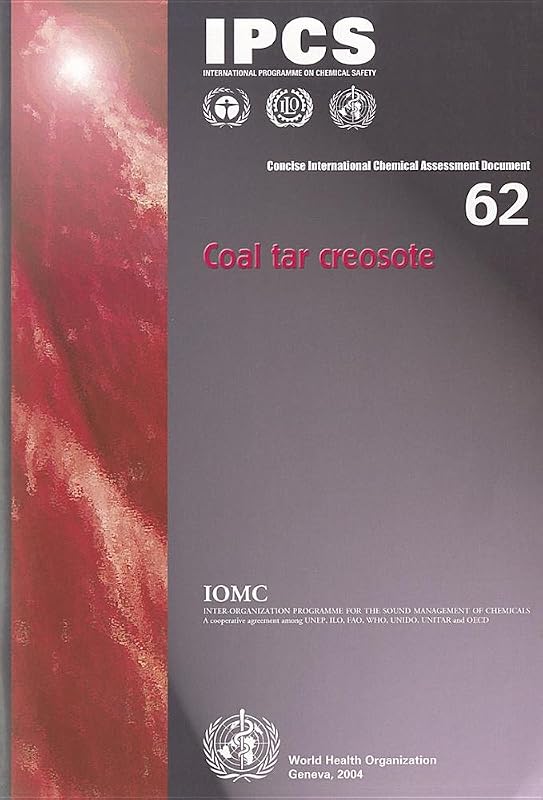
Coal Tar Creosote (Concise International Chemical Assessment Documents) by World Health Organization

Coal Tar Creosote (Concise International Chemical Assessment Documents)

World Health Organization
146 pages
World Health Organization
Dec 2004
Paperback
Health, Mind & Body WSBN
0
Readers
0
Reviews
0
Discussions
0
Quotes
This book deals with the risks to human health of coal tar creosote. Wood creosote is a different product that is used mainly in pharmaceutical preparations and is not treated in this volume. Coal tar creosote is a brownish-black/yellowish-dark green oily liquid with a characteristic odor that is obtained by the fractional distillation of crude coal tars. It consists of a mixture of several hundred, probably a thousand, chemicals, but only a limited number of them are present in amounts greater than 1%. There are six major classes of compounds in coal tar creosote: aromatic hydrocarbons, including polycyclic aromatic hydrocarbons (PAHs) and alkylated PAHs (which can constitute up to 90% of creosote) ; tar acids / phenolics; tar bases / nitrogen-containing heterocycles; aromatic amines; sulfur-containing heterocycles; and oxygen-containing heterocycles, including dibenzofurans. Coal tar creosote is a genotoxic carcinogen whose a threshold concentration has not yet been determined. Coal tar creosote is used as a wood preservative and water-proofing agent for structures on land and in marine and fresh waters as well as for railway crossing timbers and sleepers (railroad ties) , bridge and pier decking, poles, log homes, fencing, and equipment for children's playgrounds. Non-wood uses include anti-fouling applications on concrete marine pilings. Creosote can be a component of roofing pitch, fuel oil, and lamp black, and is also used as a lubricant for die moulds. It is also used as an animal and bird repellent, insecticide, animal dip, and fungicide. The majority of creosote used in the European Union (EU) is for the pressure impregnation of wood. In the USA and many other countries, the use of coal tar creosote is limited to certified applicators. Creosote-treated wood does not decay in the environment, and therefore its disposal is problematic. Creosote-treated wood should not be incinerated under uncontrolled conditions, as toxicants such as PAHs and halogenated dioxins and furans may be produced.
Join the conversation

No discussions yet. Join BookLovers to start a discussion about this book!

No reviews yet. Join BookLovers to write the first review!

No quotes shared yet. Join BookLovers to share your favorite quotes!

Earn Points
Your voice matters. Every comment, review, and quote earns you reward points redeemable for Bitcoin.
Comment +5 pts Review +20 pts Quote +7 pts Upvote +1 pt
BookMatch Quiz
Find books similar to this one
About this book
Pages 146
Publisher World Health Organiz...
Published 2004
Readers 0