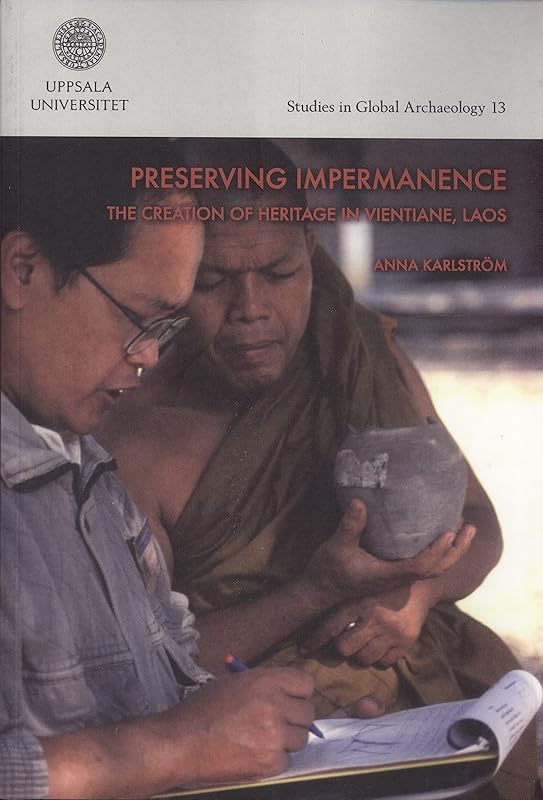
Preserving Impermanence: The Creation of Heritage in Vientiane, Laos by Anna Karlstrom

Preserving Impermanence: The Creation of Heritage in Vientiane, Laos

Anna Karlstrom
239 pages
Uppsala University, Department of Archaeology and Ancient History
Jan 2009
Staple Bound
History WSBN
0
Readers
0
Reviews
0
Discussions
0
Quotes
This thesis is about the heritage in Vientiane. In an attempt to go beyond a more traditional descriptive approach, the study aims at bringing forward a discussion about the definition, or rather the multiplicity of definitions, of the concept of heritage as such. The unavoidable tension emanating from a modern western frame of thought being applied to the geographical and cultural setting of the study provides an opportunity to develop a criticism of some of the assumptions underlying our current definitions of heritage. For this particular study, heritage is defined as to include stories, places and things. It is a heritage that is complex and ambiguous, because the stories are parallel, the definitions and perceptions of place are manifold and contested, and the things and their meaning appear altered, depending on what approach to materiality is used. The objective is not to propose how to identify and manage such a complex heritage. Rather, it is about what causes this complexity and ambiguity and what is in between the stories, places and things. In addition, the study aims to critically deconstruct the contemporary heritage discourse, which privileges material authenticity, form and fabric and the idea that heritage values are universal and should be preserved for the future and preferably forever. In Laos, Buddhism dominates as religious practice. In this context, the notion of material impermanence also governs the perception of reality. Approaches to materiality in Buddhism are related to the general ideas that things are important from a contemporary perspective and primarily as containers for spiritual values, that the spiritual values carry the connection to the past, and that heritage is primarily spiritual in nature and has little to do with physical structure and form. By exploring the concepts of restoration, destruction and consumption in such a perspective, we understand that preservation and restoration are active processes of materialisation.
Join the conversation

No discussions yet. Join BookLovers to start a discussion about this book!

No reviews yet. Join BookLovers to write the first review!

No quotes shared yet. Join BookLovers to share your favorite quotes!

Earn Points
Your voice matters. Every comment, review, and quote earns you reward points redeemable for Bitcoin.
Comment +5 pts Review +20 pts Quote +7 pts Upvote +1 pt
BookMatch Quiz
Find books similar to this one
About this book
Pages 239
Publisher Uppsala University,...
Published 2009
Readers 0