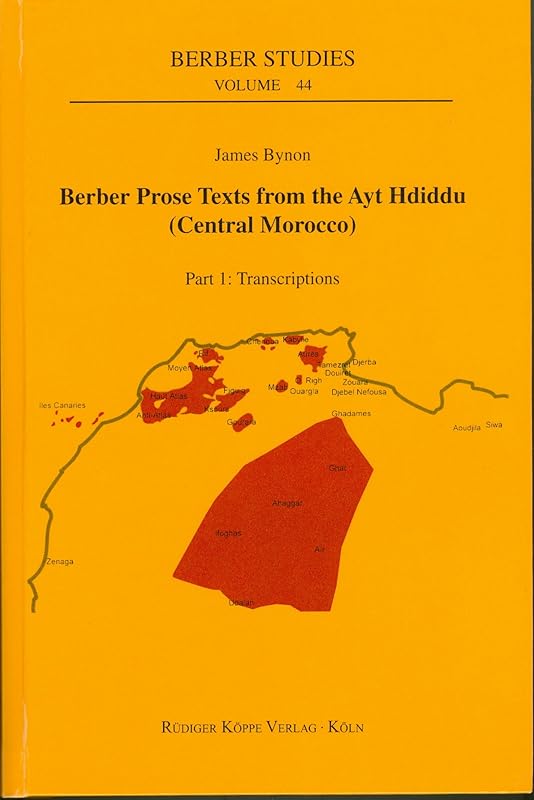
The 163 presented prose texts are in the Tamazight dialect of the Ayt Hdiduu, an ethnic group of the central High Atlas region of Morocco. They were collected by the editor over a period of several decades starting as early as in the nineteen fifties. Although they were recorded from speakers of more than one age and gender and might therefore, had they had been analysed by him in detail at the time, have shown small differences in their phonemic and morphophonemic systems, in his present transcription he has 'normalized' them all in accordance with the speech of a single individual from the tribe whose language he has over the years studied in some depth. The system of transcription the editor has adopted being broadly speaking a morphophonemic one, the interpretation of this in purely phonemic terms requires the application of a few simple rules: 1) With regard to the vowels a direct sequence of two vowels at the surface level not being tolerated by the dialect, should an underlying sequence of two vowels occur, unless these are separated on the surface by a break in the speech flow (that is to say by a silence) one of them, usually the first, must either be dropped or a so-called 'linking-y' must be inserted between them. 2) Where the underlying grammar requires a direct sequence of two instances of the same consonant or semivowel this will normally result either in a single long consonant or semivowel or else one of them (usually the first) will be dropped or else they will be separated by means of a schwa. In order to stress its non-phonemic status the editor has chosen to write this latter in index. 3) At the surface level an underlying vowel always remains vocalic. An underlying semivowel (y or w) , however, will become the corresponding vowel (i or u) when it is in absolute initial position before a consonant or is situated between two consonants.


![Foyle's War: Series 1 [VHS] by Michael Kitchen](https://ecx.images-amazon.com/images/I/514Z3ZAZW4L._SL300_.jpg)