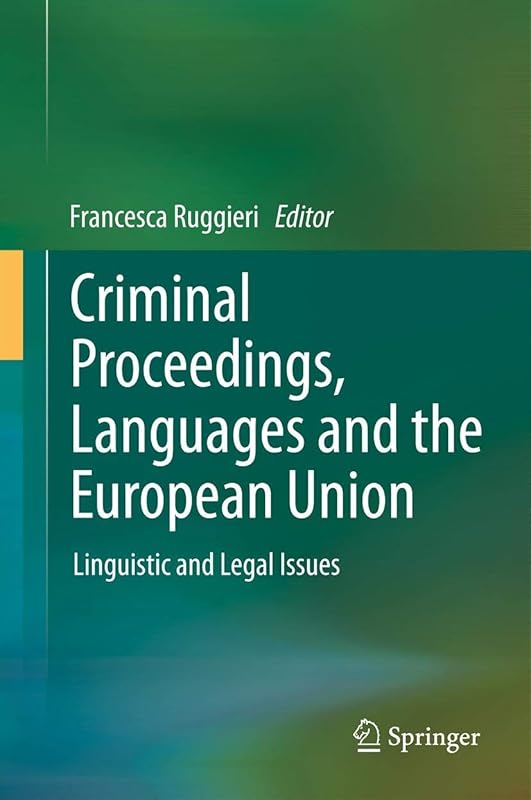
Criminal Proceedings, Languages and the European Union: Linguistic and Legal Issues by Francesca Ruggieri

Criminal Proceedings, Languages and the European Union: Linguistic and Legal Issues

Francesca Ruggieri
247 pages
Springer
Jan 2013
Hardcover
All Non-Fiction WSBN
0
Readers
0
Reviews
0
Discussions
0
Quotes
The book "Criminal proceedings, languages and the European Union: linguistic and legal issues" - the first attempt on this subject - deals with the current situation in the jurislinguistic studies, which cover comparative law, language and translation, towards the aim of the circulation of equivalent legal concepts in systems which are still very different from one another. In the absence of common cultures and languages, in criminal procedure it is possible to distinguish features that are typical of common law systems and features that are typical of civil law systems, according to the two different models of adversarial and inquisitorial trials. Therefore, the most problematic challenges are for the European Union legislator to define generic measures that can be easily implemented at the national level, and for the individual Member States to choose corresponding domestic measures that can best implement these broad definitions, so as to pursue objectives set at the European level.In this scenario, the book assesses the new framework within which criminal lawyers and practitioners need to operate under the Lisbon Treaty (Part I) , and focuses on the different versions of its provisions concerning cooperation in criminal matters, which will need to be implemented at the national level (Part III) . The book analyses the issues raised by multilingualism in the EU decision-making process and subsequent interpretation of legal acts from the viewpoint of all the players involved (EU officials, civil, penal and linguistic lawyers: Part II) , explores the possible impact of the EU legal acts concerning environmental protection, where the study of ascending and descending circulation of polysemantic words is especially relevant (Part IV) , and investigates the new legal and linguistic concepts in the field of data retention, protection of victims, European investigation orders and coercive measures (Part V) .
Join the conversation

No discussions yet. Join BookLovers to start a discussion about this book!

No reviews yet. Join BookLovers to write the first review!

No quotes shared yet. Join BookLovers to share your favorite quotes!

Earn Points
Your voice matters. Every comment, review, and quote earns you reward points redeemable for Bitcoin.
Comment +5 pts Review +20 pts Quote +7 pts Upvote +1 pt
BookMatch Quiz
Find books similar to this one
About this book
Pages 247
Publisher Springer
Published 2013
Readers 0