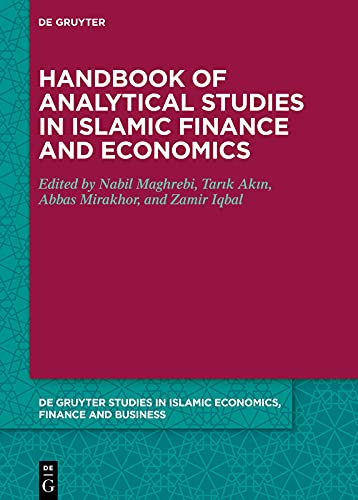
Handbook of Analytical Studies in Islamic Finance and Economics (De Gruyter Studies in Islamic Economics, Finance and Business 4) by Zamir Iqbal

Handbook of Analytical Studies in Islamic Finance and Economics (De Gruyter Studies in Islamic Economics, Finance and Business 4)

Zamir Iqbal
700 pages
De Gruyter Oldenbourg
Aug 2020
1st Edition
Business & Investing WSBN
0
Readers
0
Reviews
0
Discussions
0
Quotes

Free account. We’ll keep this book ready while you join.

Find a copy

Formats and availability vary by store. As an Amazon Associate I earn from qualifying purchases.

This handbook offers a unique and original collection of analytical studies in Islamic economics and finance, and constitutes a humble addition to the literature on new economic thinking and global finance. The growing risks stemming from higher debt, slower growth, and limited room for policy maneuver raise concerns about the ability and propensity of modern economies to find effective solutions to chronic problems. It is important to understand the structural roots of inherent imbalance, persistence-in-error patterns, policy and governance failures, as well as moral and ethical failures.      Admittedly, finance and economics have their own failures, with abstract theory bearing little relation with the real economy, uncertainties and vicissitudes of economic life. Economic research has certainly become more empirical despite, or perhaps because of, the lack of guidance from theory. The analytics of Islamic economics and finance may not differ from standard frameworks, methods, and techniques used in conventional economics, but may offer new perspectives on the making of financial crises, nature of credit cycles, roots of financial system instability, and determinants of income disparities.     The focus is placed on the logical coherence of Islamic economics and finance, properties of Islamic capital markets, workings of Islamic banking, pricing of Islamic financial instruments, and limits of debt financing, fiscal stimulus and conventional monetary policies, inter alia. Readers with investment, regulatory, and academic interests will find the body of analytical evidence to span many areas of economic inquiry, refuting thereby the false argument that given its religious tenets, Islamic economics is intrinsically narrative, descriptive and not amenable to testable implications. Thus, the handbook may contribute toward a redefinition of a dismal science in search for an elusive balance between rationality, ethics and morality, and toward a remodeling of economies based on risk sharing and prosperity for all humanity
Join the conversation

No discussions yet. Join BookLovers to start a discussion about this book!

No reviews yet. Join BookLovers to write the first review!

No quotes shared yet. Join BookLovers to share your favorite quotes!

Earn Points
Your voice matters. Every comment, review, and quote earns you reward points redeemable for Bitcoin.
Comment +5 pts Review +20 pts Quote +7 pts Upvote +1 pt
Similar Books
Find books similar to this one
About this book
Pages 700
Publisher De Gruyter Oldenbour...
Published 2020
Readers 0