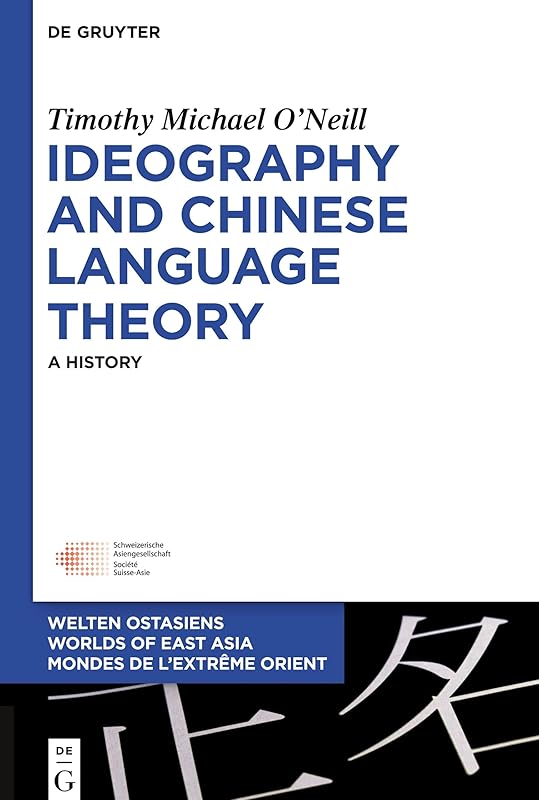
Ideography and Chinese Language Theory: A History (Welten Ostasiens / Worlds of East Asia / Mondes de l’Extrême Orient, 26) by Timothy Michael O’Neill

Ideography and Chinese Language Theory: A History (Welten Ostasiens / Worlds of East Asia / Mondes de l’Extrême Orient, 26)

Timothy Michael O’Neill
355 pages
De Gruyter
Jul 2016
Hardcover
Foreign Languages WSBN
0
Readers
0
Reviews
0
Discussions
0
Quotes
This book is a much-needed scholarly intervention and postcolonial corrective that examines why and when and how misunderstandings of Chinese writing came about and showcases the long history of Chinese theories of language. 'Ideography' as such assumes extra-linguistic, trans-historical, universal 'ideas' which are an outgrowth of Platonism and thus unique to European history. Classical Chinese discourse assumes that language (and writing) is an arbitrary artifact invented by sages for specific reasons at specific times in history. Language by this definition is an ever-changing technology amenable to historical manipulation; language is not the House of Being, but rather a historically embedded social construct that encodes quotidian human intentions and nothing more. These are incommensurate epistemes, each with its own cultural milieu and historical context. By comparing these two traditions, this study historicizes and decolonializes popular notions about Chinese characters, exposing the Eurocentrism inherent in all theories of ideography. Ideography and Chinese Language Theory will be of significant interest to historians, sinologists, theorists, and scholars in other branches of the humanities.
Join the conversation

No discussions yet. Join BookLovers to start a discussion about this book!

No reviews yet. Join BookLovers to write the first review!

No quotes shared yet. Join BookLovers to share your favorite quotes!

Earn Points
Your voice matters. Every comment, review, and quote earns you reward points redeemable for Bitcoin.
Comment +5 pts Review +20 pts Quote +7 pts Upvote +1 pt
BookMatch Quiz
Find books similar to this one
About this book
Pages 355
Publisher De Gruyter
Published 2016
Readers 0