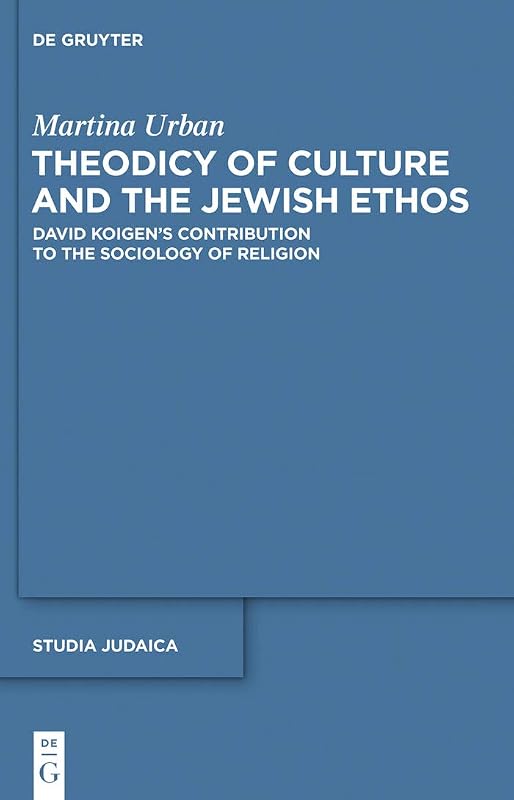
Theodicy of Culture and the Jewish Ethos: David Koigen’s Contribution to the Sociology of Religion (Studia Judaica Book 63) by Martina Urban

Theodicy of Culture and the Jewish Ethos: David Koigen’s Contribution to the Sociology of Religion (Studia Judaica Book 63)

Martina Urban
277 pages
De Gruyter
Jul 2012
Hardcover
Religion & Spirituality WSBN
0
Readers
0
Reviews
0
Discussions
0
Quotes

Free account. We’ll keep this book ready while you join.

Find a copy

Formats and availability vary by store. As an Amazon Associate I earn from qualifying purchases.

This volume presents the theory of culture of the Russian‑born German Jewish social philosopher David Koigen (1879-1933) . Heir to Hermann Cohen's neo‑Kantian interpretation of Judaism, he transforms the religion of reason into an ethical Intimitätsreligion. He draws upon a great variety of intellectual currents, among them, Max Scheler's philosophy of values, the historical sociology of Max Weber, the sociology of religion of Émile Durkheim, Ernst Troeltsch and Georg Simmel and American pragmatism. Influenced by his personal experience of marginality in German academia yet the same time unconstrained by the dictates of the German Jewish discourse, Koigen shapes these theoretical strands into an original argument which unfolds along two trajectories: theodicy of culture and ethos. Distinguished from ethics, ethos identifies the non-formal factors that foster a group's sense of collective identity as it adapts to continuous change. From a Jewish perspective, ethos is grounded in the biblical covenant as the paradigm of a social contract and corporate liability. Although the normative content of the covenantal ethos is subject to gradual secularization, its metaphysical and existential assumptions, Koigen argues, continue to inform Jewish self-understanding. The concept of ethos identifies the dialectic of tradition as it shapes Jewish religious consciousness, and, in turn, is shaped by the evolving cultural and axiological sensibilities. In consonance, Jewish identity cannot be reduced to ethnicity or a purely secular culture. Urban develops these fragmentary and inchoate theories into a sociology of religious knowledge and suggests to read Koigen not just as a Jewish sociologist but as the first sociologist of Judaism who proposes to overcome the dogmatic anti-metaphysical stance of European sociology.
Join the conversation

No discussions yet. Join BookLovers to start a discussion about this book!

No reviews yet. Join BookLovers to write the first review!

No quotes shared yet. Join BookLovers to share your favorite quotes!

Earn Points
Your voice matters. Every comment, review, and quote earns you reward points redeemable for Bitcoin.
Comment +5 pts Review +20 pts Quote +7 pts Upvote +1 pt
Similar Books
Find books similar to this one
About this book
Pages 277
Publisher De Gruyter
Published 2012
Readers 0