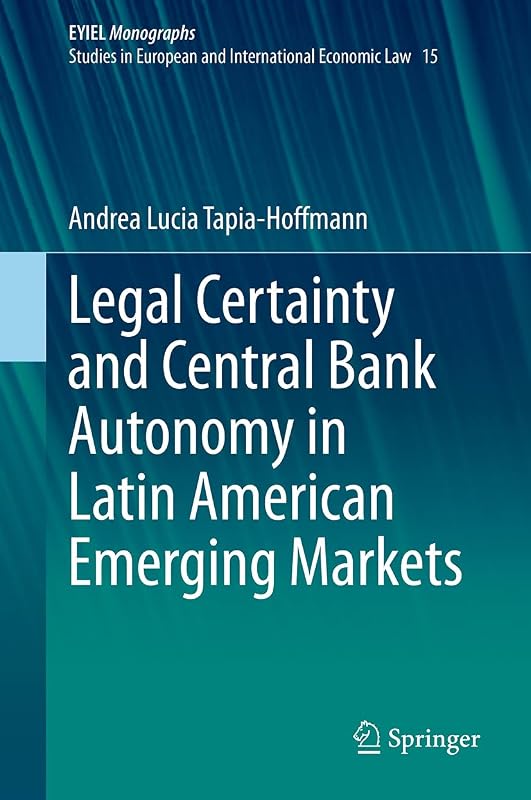
Legal Certainty and Central Bank Autonomy in Latin American Emerging Markets (European Yearbook of International Economic Law 15) by Andrea Lucia Tapia-Hoffmann

Legal Certainty and Central Bank Autonomy in Latin American Emerging Markets (European Yearbook of International Economic Law 15)

Andrea Lucia Tapia-Hoffmann
497 pages
Springer
Apr 2021
1st ed. 2021 Edition
Business & Investing WSBN
0
Readers
0
Reviews
0
Discussions
0
Quotes

Free account. We’ll keep this book ready while you join.

Find a copy

Formats and availability vary by store. As an Amazon Associate I earn from qualifying purchases.

This book provides a comparative analysis of the legal frameworks of six Latin American central banks to determine whether there is legal certainty regarding central bank autonomy. Based on this, it ascertains whether the way in which legal institutions are designed - specifically those that rule the autonomy of the central bank - provides reasons to believe that central banks can keep inflation at bay even if governments face fiscal problems or pursue contradictory objectives. The analysis covers three key areas: a constitutional analysis, a detailed study of the central bank statutes and a study of a number of underexplored threats to central bank autonomy. After defining and identifying different types of legal certainty and linking them to the credibility of government promises, the author goes on to examine the grounds that the law provides for confidence that central banks operate independently of political influence. The secondpart of the book focuses on a granular analysis of the legal design of the central banks' objectives and autonomy. Lastly, the third part features two case studies that represent little-known and unusual institutional threats to legal certainty relating to central bank autonomy, such as the interventions by the Constitutional Court of Colombia in the autonomy of the Colombian central bank, and the interventions of the Argentinean executive and legislative branches in the autonomy of Argentina's central bank through stabilization plans introduced via emergency laws and decrees.In sum, the book suggests that there are serious doubts about the ability of Latin American central banks to maintain price stability over time. Although central banks were granted a degree of autonomy, authorities in Latin American countries are able to affect central bank decisions. Most importantly, a lack of clarity, inconsistencies, or generous exceptions in the law provide ways for authorities to influence central banks even without bending or disregarding the rules.
Join the conversation

No discussions yet. Join BookLovers to start a discussion about this book!

No reviews yet. Join BookLovers to write the first review!

No quotes shared yet. Join BookLovers to share your favorite quotes!

Earn Points
Your voice matters. Every comment, review, and quote earns you reward points redeemable for Bitcoin.
Comment +5 pts Review +20 pts Quote +7 pts Upvote +1 pt
Similar Books
Find books similar to this one
About this book
Pages 497
Publisher Springer
Published 2021
Readers 0