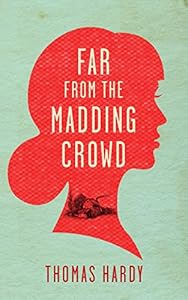
Tess of the d'Urbervilles (published in 1891) : A Pure Woman Faithfully Presented is a novel by Thomas Hardy. It initially appeared in a censored and serialisedversion, published by the British illustrated newspaper The Graphic in 1891 and in book form in 1892. Though now considered a major nineteenth-century English novel and possibly Hardy's fictional masterpiece, Tess of the d'Urbervilles received mixed reviews when it first appeared, in part because it challenged the sexual morals of late Victorian England. The novel is set in impoverished rural England, Thomas Hardy's fictional Wessex, during the Long Depression of the 1870s. Tess is the oldest child of John and Joan Durbeyfield, uneducated peasants. However, John is given the impression by Parson Tringham that he may have noble blood, as "Durbeyfield" is a corruption of "D'Urberville", the surname of an extinct noble Norman family. Knowledge of this immediately goes to John's head. That same day, Tess participates in the village May Dance, where she meets Angel Clare, youngest son of Reverend James Clare, who is on a walking tour with his two brothers. He stops to join the dance and partners several other girls. Angel notices Tess too late to dance with her, as he is already late for a promised meeting with his brothers. Tess feels slighted. Author Thomas Hardy (2 June 1840 - 11 January 1928) was an English novelist and poet. A Victorian realist in the tradition of George Eliot, he was influenced both in his novels and in his poetry by Romanticism, especially William Wordsworth. He was highly critical of much in Victorian society, especially on the declining status of rural people in Britain, such as those from his native South West England. While Hardy wrote poetry throughout his life and regarded himself primarily as a poet, his first collection was not published until 1898. Initially, therefore, he gained fame as the author of such novels as Far from the Madding Crowd (1874) , The Mayor of Casterbridge (1886) , Tess of the d'Urbervilles (1891) , and Jude the Obscure (1895) . During his lifetime, Hardy's poetry was acclaimed by younger poets (particularly the Georgians) who viewed him as a mentor. After his death his poems were lauded by Ezra Pound, W. H. Auden and Philip Larkin. Many of his novels concern tragic characters struggling against their passions and social circumstances, and they are often set in the semi-fictional region of Wessex; initially based on the medieval Anglo-Saxon kingdom, Hardy's Wessex eventually came to include the counties of Dorset, Wiltshire, Somerset, Devon, Hampshire and much of Berkshire, in southwest and south central England. Two of his novels, Tess of the d'Urbervillesand Far from the Madding Crowd, were listed in the top 50 on the BBC's survey The Big Read. Thomas Hardy was born on 2 June 1840 in Higher Bockhampton (then Upper Bockhampton) , a hamlet in the parish of Stinsford to the east of Dorchester in Dorset, England, where his father Thomas (1811-1892) worked as a stonemason and local builder, and married his mother Jemima (née Hand; 1813-1904) in Beaminster, towards the end of 1839. Jemima was well-read, and she educated Thomas until he went to his first school at Bockhampton at the age of eight. For several years he attended Mr. Last's Academy for Young Gentlemen in Dorchester, where he learned Latin and demonstrated academic potential. Because Hardy's family lacked the means for a university education, his formal education ended at the age of sixteen, when he became apprenticed to James Hicks, a local architect.