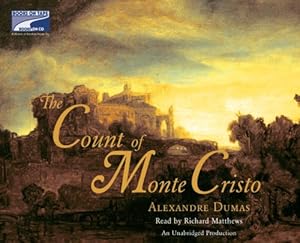
The Count of Monte Cristo
Alexandre Dumas
In 1815 Edmond Dantes, a young and successful merchant sailor who has just recently been granted the succession of his erstwhile captain Leclere, returns to Marseille to marry his Catalan fiancée Mercedes. Thrown in prison for a crime he has not committed, Edmond Dantes is confined to the grim fortress of If. There he learns of a great hoard of treasure hidden on the Isle of Monte Cristo and he becomes determined not only to escape, but also to unearth the treasure and use it to plot the destruction of the three men responsible for his incarceration. Read more Continue reading Read less FROM THE BACK COVER
"A piece of perfect storytelling." - Robert Louis Stevenson
From the Trade Paperback edition. --This text refers to an alternate kindleedition edition. FROM AUDIOFILE
Dumas's sweeping adventure tale of the wrongly imprisoned Edmond Dantés, his transformation into the Count of Monte Cristo, and the long and elaborate course of his revenge on his enemies could certainly be a challenge for audiobook listeners. The intricate plot and dozens of characters require 52 hours in this unabridged production. Fans of the book will likely appreciate the care taken in the creation of this ambitious production. The recording is crisp and clean, narrator Bill Homewood's pace matches the action well, and the volume is consistent throughout. Homewood invests each character with personality and heart, and throughout the tale his reading remains clear, forceful, and committed. M.G. AudioFile 2010, Portland, Maine --This text refers to an alternate kindleedition edition. REVIEW
''Dumas was... a summit of art. Nobody ever could, or did, or will improve upon Dumas's romances and plays.'' --George Bernard Shaw
''(Audiobook narrator) John Lee imbues this classic with exactly the right balance of solemnity and compassion. His light accents for characters of various nationalities give them individual personalities without overdoing them in the slightest. Lee works with Dumas's text to give each character complexity and emotion. The listener regrets the stor's end, wishing to live with Edmund and his adventures just a little longer.'' --AudioFile
''Popular writers of contemporary action thrillers owe a debt of gratitude to Dumas, whose famous early-nineteenth-century protagonist, Edmond Dantés, is a loner and a vigilante, single-mindedly bent on redressing wrong and infinitely capable of achieving that end, no matter how extreme or wildly improbable the means. From the first page of the novel, Dumas separates the 'good guys' from the bad and pulls the reader into the drama, squarely on Edmond's side . . . (audiobook narrator) Lee's deep muscular voice works well for this swashbuckler . . . his reading is highly expressive, his pace brisk, his tone rich with foreboding.'' --Kliatt --This text refers to an alternate kindleedition edition. EXCERPT. REPRINTED BY PERMISSION. ALL RIGHTS RESERVED.
Chapter I
ON FEBRUARY 24, 1815, the watchtower at Marseilles signaled the arrival of the three-master Pharaon, coming from Smyrna, Trieste and Naples.
The quay was soon covered with the usual crowd of curious onlookers, for the arrival of a ship is always a great event in Marseilles, especially when, like the Pharaon, it has been built, rigged and laden in the city and belongs to a local shipowner.
Meanwhile the vessel was approaching the harbor under topsails, jib and foresail, but so slowly and with such an air of melancholy that the onlookers, instinctively sensing misfortune, began to wonder what accident could have happened on board. However, the experienced seamen among them saw that if there had been an accident, it could not have happened to the ship herself, for she had every appearance of being under perfect control. Standing beside the pilot, who was preparing to steer the Pharaon through the narrow entrance of the harbor, was a young man who, with vigilant eyes and rapid gestures, watched every movement of the ship and repeated each of the pilot's orders.
The vague anxiety hovering over the crowd affected one man so much that he could not wait until the ship entered the harbor: he leaped into a small boat and ordered the boatman to row him out to meet the Pharaon.
When he saw this man coming toward him, the young sailor left his post beside the pilot and walked over to the side of the ship, holding his hat in his hand. He was a tall, slender young man, no more than twenty years old, with dark eyes and hair as black as ebony. His whole manner gave evidence of that calmness and resolution peculiar to those who have been accustomed to facing danger ever since their childhood.
"Ah, it's you, Dantès!" cried the man in the boat. "What's happened? Why does everything look so gloomy on board?"
"A great misfortune, Monsieur Morrel!" replied the young man. "We lost our brave Captain Leclère off Civitavecchia."
"What about the cargo?" asked the shipowner eagerly.
"It arrived safely, Monsieur Morrel, and I think you'll be satisfied on that score, but poor Captain Leclère--"
"What happened to him?" asked the shipowner, visibly relieved.
"He died of brain fever, in horrible agony. He's now at rest off the Isle of II Giglio, sewed up in his hammock with one cannon ball at his head and another at his feet." The young man smiled sadly and added, "How ironic-he waged war against the English for ten long years and then died in his bed like anyone else."
"Well, we're all mortal," said the shipowner, "and the old must make way for the young, otherwise there would be no promotion."
As they were passing the Round Tower, the young sailor called out, "Make ready to lower topsails, foresail and jib!" The order was executed as smartly as on board a man-of-war. "Lower away and brail all!" At this last order all the sails were lowered and the ship's speed became almost imperceptible.