


James Joyce's Negations: Irony, Indeterminacy and Nihilism in "Ulysses" and OtherWritings by Brian Cosgrove

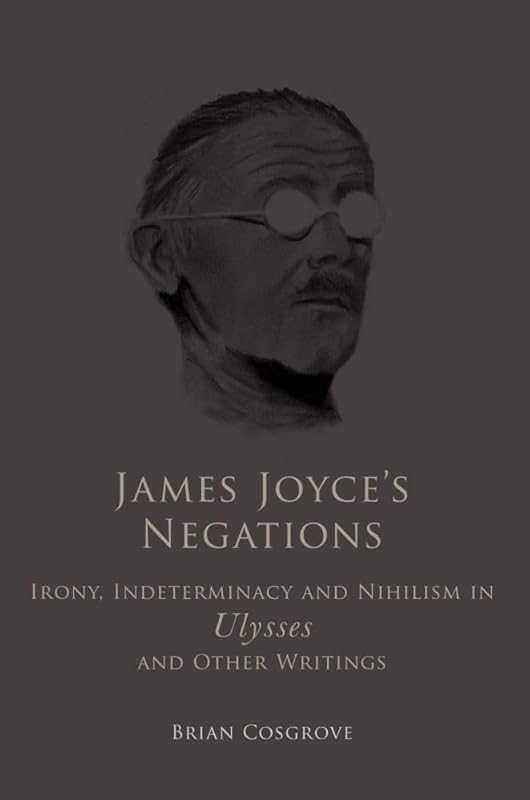
James Joyce's Negations: Irony, Indeterminacy and Nihilism in "Ulysses" and OtherWritings

Brian Cosgrove
272 pages
University College Dublin Press
Oct 2007
Hardcover
All Fiction WSBN
0
Readers
0
Reviews
0
Discussions
0
Quotes
The main purpose of this book is to validate a reading of Joyce in negative terms. Central to the enquiry is an examination of the roles of irony and of indeterminacy. Irony, interpreted in metaphysical rather than merely rhetorical terms, is envisaged as deriving from two separate if related orientations, one associated with Friedrich Schlegel, the other with Gustave Flaubert. Insofar as Joyce's work (including "Ulysses") owes more to the latter than the former, it forgoes the genial humour central to Schlegel's theories, and embraces instead the ironic detachment and formal control of a Flaubertian perspective. Such irony (which entails a suspicion of sentiment and a related dehumanisation of character, as in some of the stories in Dubliners) becomes normative in Joyce, and along with a similarly deflationary parody pervades "Ulysses". In addition, a persistent indeterminacy is established as early as 'The Dead', so that it becomes impossible in that story to adjudicate between not just contradictory but mutually exclusive interpretations. Such indeterminacy is pushed to further extremes in "Ulysses", with its notorious proliferation of narrative perspectives.As a corollary to the work's encyclopaedic inclusiveness and quotidian particularism, every detail tends to assume the same significance as every other; the consequence being that (in Gyorgy Lukacs' famous formulation) we lose all sense of any 'hierarchy of meaning'. From that it is but a step to Franco Moretti's assessment that in "Ulysses" everyday existence remains 'inert, opaque - meaningless', and that in fact the whole point is to represent the meaningless precisely 'as meaningless'. Indeterminacy, in effect, ushers in the possibility of nihilism. The analysis of "Ulysses" culminates with the attempt (unavailing in both cases) to discover in either Bloom or Molly a genuine source of countervailing affirmation. The study concludes with a brief consideration of the polysemic vocabulary of "Finnegans Wake" as a logical extrapolation of the poetics of indeterminacy.
Join the conversation

No discussions yet. Join BookLovers to start a discussion about this book!

No reviews yet. Join BookLovers to write the first review!

No quotes shared yet. Join BookLovers to share your favorite quotes!

Earn Points
Your voice matters. Every comment, review, and quote earns you reward points redeemable for Bitcoin.
Comment +5 pts Review +20 pts Quote +7 pts Upvote +1 pt
BookMatch Quiz
Find books similar to this one
About this book
Pages 272
Publisher University College D...
Published 2007
Readers 0