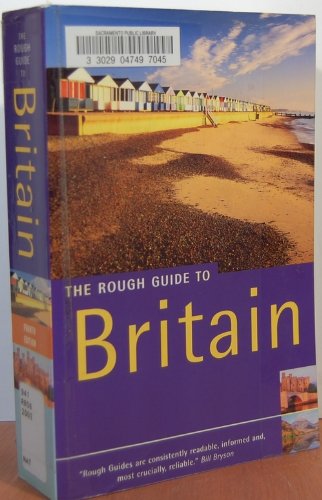
The Rough Guide to Britain
Rough Guides
1376 pages
Rough Guides
Jul 2002
Paperback
Travel
WSBN
INTRODUCTION If ever a nation were both hostage to and beneficiary of its history, its Britain. The single most important thing to remember when travelling here is that youre visiting not one country, but three: England, Wales and Scotland. For visitors foreign and domestic, that means contending with three capital cities (London, Cardiff and Edinburgh) and three sets of national identity not to mention the myriad accent shifts as you move between them. The truth is that were you to plan a country from scratch, you wouldnt even try to corral these three fiercely contradictory nations into a United Kingdom*. Theyve had centuries to get used to each other, but theres still very little love lost: Wales has long been resentful of English dominance, Scotland is happiest as far away from both as possible, northern England is contemptuous of the south, and Londoners are convinced theyre in a league of their own. That said, most visitors dont let a little social disunity get in the way of seeing the sights. Theres enough here for a lifetimes travels from London, a city of world renown, to remote Scottish fishing villages; from the Welsh valleys to Englands post-industrial heartland; from Lands End to John OGroats; and the North Sea to the Irish Sea. However, travelling around Britain today is not without its idiosyncrasies. The train system, infamously, is in disarray, with commuters and long-distance travellers in a semi-permanent state of delay and revolt. The arterial roads arent much better, often gridlocked around major cities, while the decrepit condition of many state-run hospitals and schools starved for decades of coherent investment and direction, and now well below European and North American averages commonly makes headlines in the daily newspapers. And if youve just arrived clutching your euros from a tour of "The Continent", free of border controls and exchange rates, youll swiftly be disabused of the notion of Britain being an integral part of Europe. The country has dithered for decades about its postwar and, more specifically, post-imperial role: having ruled the roost for several hundred years, Brits are increasingly uncertain about their place in the new order. Paradoxically, its the Welsh and the Scots, for so long under the English thumb, who have emerged with their national identities intact and tangible political power embodied in their own parliamentary assemblies. The English, still without a regional voice, are left unsure of how to modernize their institutions, ever-fearful of conflict erupting between town and country, north and south, rich and poor, blacks, Asians and whites, and increasingly lagging behind the social and political change that is being wrought as effectively in Edinburgh as in Brussels. England remains the dominant and most urbanized member of the British partnership, but crossing the border into predominantly rural Wales brings you into an unmistakably Celtic land, while in Scotland (a! nation whose absorption into the state was rather more recent) the presence of a profoundly non-English worldview is striking. Across the country, virtually every town bears a mark of former wealth and power, whether it be a Gothic cathedral financed from a monarchs treasury, a parish church funded by the tycoons of medieval trade, or a triumphalist Victorian civic building, raised on the income of the British Empire. Elsewhere, youll find old dockyards from which the Royal Navy patrolled the oceans, and mills that employed whole town populations. Meanwhile Britains museums and galleries several of them ranking among the worlds finest, and most of the major ones with free admission are full of treasures trawled from its imperial conquests. In Londons and Bristols vibrant music scene, in the fashionable restaurants and bars of Manchester and Glasgow, in the outstanding contemporary architecture on show in Cardiff and Newcastle, theres a buzz, a "feel-good" factor, that is palpable. Indeed, theres always been an innovative flair to British popular culture, which contrasts sharply with the bucolic view of Britain that many tourist boards favour. The countryside may yield all manner of delights, from walkers trails around the hills and lakes, through prehistoric stone circles, to traditional villages and their pubs; but Britains characterful and diverse urban culture is fast becoming as popular a draw as its countryside and history have ever been.