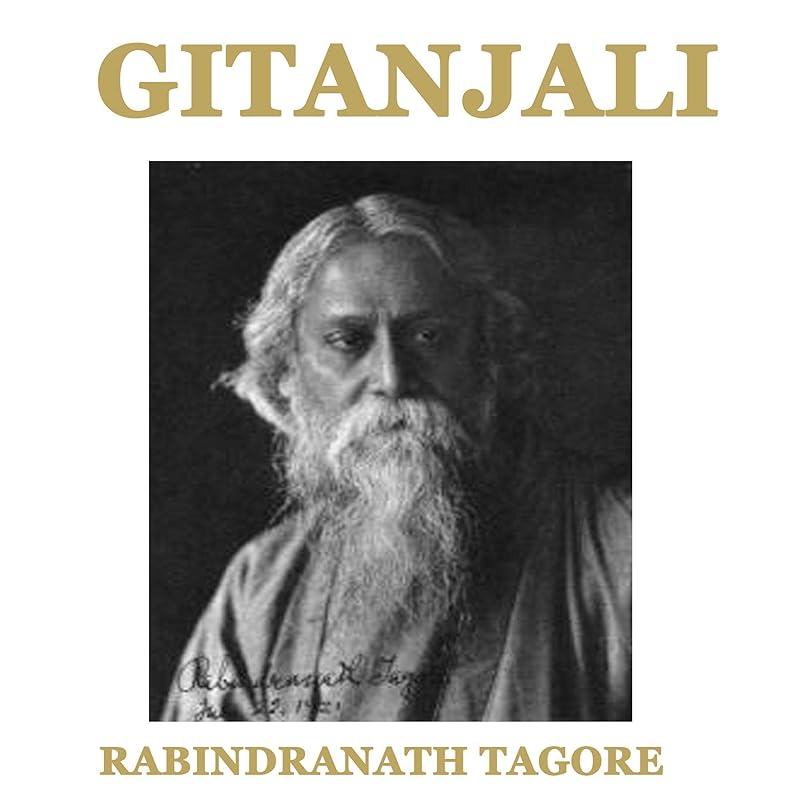
To hear one line of his is to forget all the troubles of the world. Rabindranath Tagore writes music for his words, and one understands at every moment that he is so abundant, so spontaneous, so daring his passion, so full of surprise, because he is doing something which has never seemed strange, unnatural, or in need of defense. At every moment the heart of this poet flows outward without derogation or condescension, for it knows that most will understand; and it has filled itself with the circumstances of life. This version has a new introduction by Swami Vivekananda on Bhakti or Devotion, the yoga of surrender.
Read more ABOUT THE AUTHOR
"Rabindranath Tagore (7 May 1861 - 7 August 1941) , also known by the sobriquet Gurudev, was a Bengali poet, Brahmo Samaj philosopher, visual artist, playwright, novelist, and composer whose works reshaped Bengali literature and music in the late 19th and early 20th centuries. He became Asia's first Nobel laureate when he won the 1913 Nobel Prize in Literature. A Pirali Bengali Brahmin from Calcutta, Tagore first wrote poems at the age of eight. At the age of sixteen, he published his first substantial poetry under the pseudonym Bhanushingho ("Sun Lion") and wrote his first short stories and dramas in 1877. His home schooling, life in Shilaidaha, and travels made Tagore a nonconformist and pragmatist. Tagore strongly protested against the British Raj and gave his support to the Indian Independence Movement and Mahatma Gandhi. Tagore's life was tragic-he lost virtually his entire family and was devastated to witness Bengal's decline-but his life's work endured, in the form of his poetry and the institution he founded, Visva-Bharati University. Tagore wrote novels, short stories, songs, dance-dramas, and essays on political and personal topics. Gitanjali (Song Offerings) , Gora (Fair-Faced) , and Ghare-Baire (The Home and the World) are among his best-known works. His verse, short stories, and novels, which often exhibited rhythmic lyricism, colloquial language, meditative naturalism, and philosophical contemplation, received worldwide acclaim. Tagore was also a cultural reformer and polymath who modernised Bengali art by rejecting strictures binding it to classical Indian forms. Two songs from his rabindrasangeet canon are now the national anthems of Bangladesh and India: the Amar Shonar Bangla and the Jana Gana Mana." (Quote from wikipedia.org) Read more