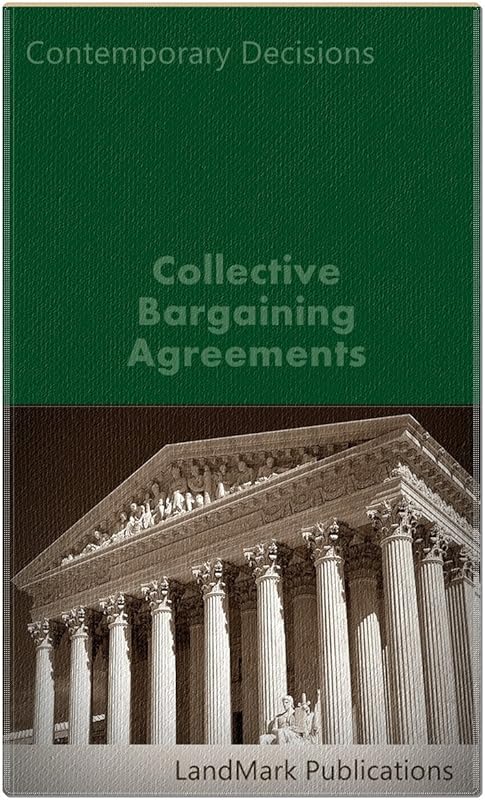

Collective Bargaining Agreements (Employment Law Series) by LandMark Publications

Collective Bargaining Agreements (Employment Law Series)

LandMark Publications
542 pages
LandMark Publications
Jan 2019
Paperback
All Non-Fiction WSBN
0
Readers
0
Reviews
0
Discussions
0
Quotes
THIS CASEBOOK contains five U. S. Supreme Court decisions and a selection of 194 U. S. Court of Appeals decisions that analyze and discuss issues which affect the interpretation and enforcement of collective bargaining agreements. The selection of decisions spans from 2009 to the date of publication. Section 301 of the LMRA [Labor Management Relations Act] provides that "suits for violation of contracts between an employer and a labor organization representing employees . . . may be brought in any district court of the United States having jurisdiction of the parties." 29 U.S.C. § 185(a) . This provision "not only provides federal courts with jurisdiction over employment disputes covered by collective bargaining agreements, but also directs federal courts to fashion a body of federal common law to resolve such disputes." McCormick v. AT&T Tech., Inc., 934 F.2d 531, 534 (4th Cir. 1991) (en banc) . Moreover, to ensure uniform interpretation of collective bargaining agreements and to protect the power of arbitrators, the Supreme Court has found that § 301 preempts and entirely displaces "any state cause of action for violation of contracts between an employer and a labor organization." Franchise Tax Bd. v. Constr. Laborers Vacation Trust, 463 U.S. 1, 23 (1983) (emphasis added) (internal quotation marks and citation omitted) . Barton v. House of Raeford Farms, Incorporated, (4th Cir. 2014) . As a result, a plaintiff may not rely on state law "as an independent source of private rights to enforce collective bargaining contracts." Caterpillar Inc. v. Williams, 482 U.S. 386, 394 (1987) (internal quotation marks and citation omitted) . Not only does this mean that a plaintiff may not pursue a state law breach of contract claim to enforce a collective bargaining agreement, but it also means that a plaintiff may not "evade the requirements of § 301" through artful pleading. Allis-Chalmers Corp. v. Lueck, 471 U.S. 202, 211 (1985) . Accordingly, when resolution of a state law claim depends substantially on the analysis of a collective bargaining agreement's terms, it must either be treated as a claim under § 301, subject to dismissal if the collective bargaining agreement's grievance and arbitration procedures have not been followed, or alternatively be dismissed as preempted by § 301. Id. at 220-21; see also Davis v. Bell Atl.-W. Va., Inc., 110 F.3d 245, 247 (4th Cir. 1997) . Barton v. House of Raeford Farms, Incorporated, ibid.
Join the conversation

No discussions yet. Join BookLovers to start a discussion about this book!

No reviews yet. Join BookLovers to write the first review!

No quotes shared yet. Join BookLovers to share your favorite quotes!

Earn Points
Your voice matters. Every comment, review, and quote earns you reward points redeemable for Bitcoin.
Comment +5 pts Review +20 pts Quote +7 pts Upvote +1 pt
BookMatch Quiz
Find books similar to this one
About this book
Pages 542
Publisher LandMark Publication...
Published 2019
Readers 0