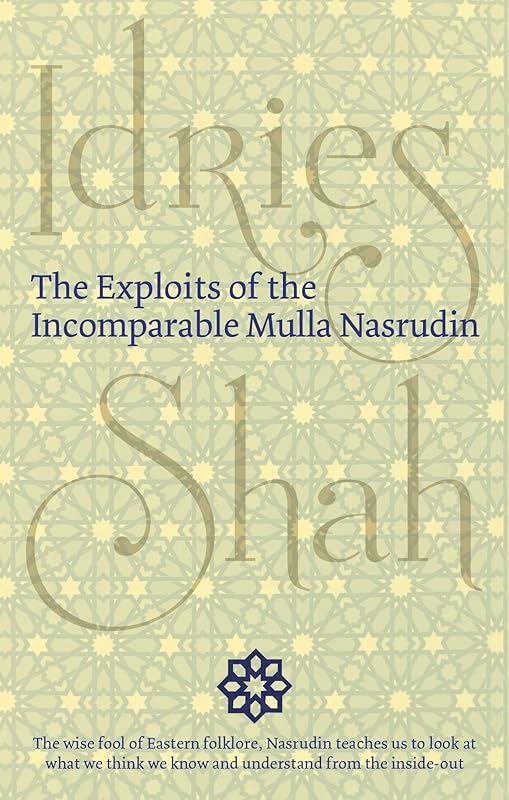
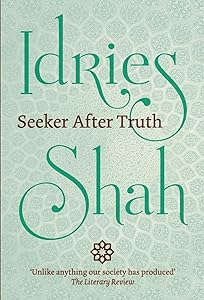
The Exploits of the Incomparable Mulla Nasrudin
Idries Shah
128 pages
ISF Publishing
Jul 2020
Hardcover
Default
WSBN
Warning: when you pop, you can't stop!
Like a famous brand of crisps, these stories are addictive.
Read one, the saying goes, and you'll be stuck reading seven.
In fact, Mulla Nasrudin jokes function like memes - working their way into the fabric of society, subtly influencing thought.
They have no calories, so indulge without guilt!
Read more Continue reading Read less ABOUT THE AUTHOR
Born in 1924 into an aristocratic Afghan family, Idries Shah created a large body of literary work, most of which considered elements of "Eastern Thought", especially Sufism and Sufi thought. Some of his best known works include The Sufis and several collections of teaching stories featuring Nasrudin. Shah devoted his life to collecting, selecting and translating Sufi books and key works of Sufi classical literature, adapting them to the needs of the West and disseminating them in the Occident. Called by some "practical philosophy", by others "templates in straight thinking" - these works represent centuries of Sufi thought and Islamic thought aimed at the development of human potential to its fullest extent. They stress virtues such as commonsense, clear-thinking and humor to counter cant and religious dogma. As such they are vital works in the area of Islamic philosophy, and may be viewed as an antidote to radicalism and fanaticism much needed in the world today. Shah's books have been translated into dozens of languages, have sold in their millions, and are regarded as a cultural bridge between West and East. His work and contribution to Sufism are represented by The Idries Shah Foundation. --This text refers to an alternate kindleedition edition. REVIEW
"... completely captivating ... a book for children of all and every age." -- The Irish Times, December 17, 1966
"... far superior to Aesop ..." -- The Times, November 29, 1973
"... jokes that arouse laughter in the simple and contemplation in the illuminated." -- The Listener, December 15, 1966
"A humorous masterpiece ... an outstanding book ..." -- Birmingham Post, November 26, 1966
"A major psychological and cultural event of our time." -- Psychology Today
"All will welcome the telling by Idries Shah." -- Times Educational Supplement
"Nasrudin, forced to review this book, might ask where folly ended and wisdom began." -- Brian W. Aldiss, Oxford Mail, November 3, 1966
"One can pick up this astonishing book again and again, finding each time new insights ..." -- BBC's Bookcase, February 14, 1974
"One is immediately forced to use one's mind in a new way." -- New York Times
"The humour is there for all to appreciate. There is wisdom to be detected, too." -- West Lancashire Evening Gazette, January 9, 1974
"The most interesting books in the English language." -- Saturday Review --This text refers to an alternate kindleedition edition. EXCERPT. REPRINTED BY PERMISSION. ALL RIGHTS RESERVED.
COOKING BY CANDLE
Nasrudin made a wager that he could spend a night on a near-by mountain and survive, in spite of ice and snow. Several wags in the teahouse agreed to adjudicate. Nasrudin took a book and a candle and sat through the coldest night he had ever known. In the morning, half-dead, he claimed his money.
"Did you have nothing at all to keep you warm?" asked the villagers.
"Nothing."
"Not even a candle?"
"Yes, I had a candle."
"Then the bet is off."
Nasrudin did not argue.
Some months later he invited the same people to a feast at his house. They sat down in his reception room, waiting for the food. Hours passed.
They started to mutter about food.
"Let's go and see how it is getting on," said Nasrudin.
Everyone trooped into the kitchen. They found an enormous pot of water, under which a candle was burning. The water was not even tepid.
"It is not ready yet," said the Mulla. "I don't know why - it has been there since yesterday."
THE SHORT CUT
Walking home one wonderful morning, Nasrudin thought that it would be a good idea to take a short cut through the woods. "Why", he asked himself; "should I plod along a dusty road when I could be communing with Nature, listening to the birds and looking at the flowers? This is indeed a day of days; a day for fortunate pursuits!"
So saying, he launched himself into the greenery. He had not gone very far, however, when he fell into a pit, where he lay reflecting.
"It is not such a fortunate day, after all," he meditated; "in fact it is just as well that I took this short cut. If things like this can happen in a beautiful setting like this, what might not have befallen me on that nasty highway?"
Excerpted from The Exploits of the Incomparable Mulla Nasrudin by Idries Shah. Copyright 1983. Reprinted by permission. All rights reserved.
--This text refers to an alternate kindleedition edition. Read more Continue reading Read less