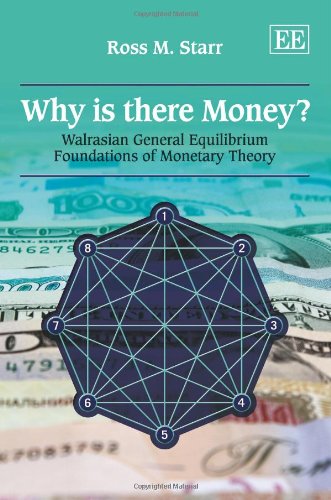
Why is there Money?: Walrasian General Equilibrium Foundations of Monetary Theory by Ross M. Starr

Why is there Money?: Walrasian General Equilibrium Foundations of Monetary Theory

Ross M. Starr
176 pages
Edward Elgar Publishing
Apr 2012
Hardcover
Business & Investing WSBN
0
Readers
0
Reviews
0
Discussions
0
Quotes
The microeconomic foundation of the theory of money has long represented a puzzle to economic theory. Why is there Money? derives the foundations of monetary theory from advanced price theory in a mathematically precise family of trading post models. . It has long been recognized that the fundamental theoretical analysis of a market economy is embodied in the Arrow-Debreu-Walras mathematical general equilibrium model, with one great deficiency: the analysis cannot accommodate money and financial institutions. In this groundbreaking book, Ross M. Starr addresses this problem directly, by expanding the Arrow-Debreu model to include a multiplicity of trading opportunities, with the resultant endogenous derivation of money as the carrier of value among them. This fundamental breakthrough is achieved while maintaining the Walrasian general equilibrium price-theoretic structure, augmented primarily by the introduction of separate bid and ask prices reflecting transaction costs. The result is foundations of monetary theory consistent with and derived from modern price theory. . This fascinating book will provide a stimulating and thought-provoking read for academics and postgraduate students focusing on economics, macroeconomics, macroeconomic policy and finance, money and banking. Central bankers will also find much to interest them within this book. . Contents: Introduction: Why is There No Money? 1. Why is There Money? 2. An Economy Without Money 3. The Trading Post Model 4. An Elementary Linear Example: Liquidity Creates Money 5. Absence of Double Coincidence of Wants is Essential to Monetization in a Linear Economy 6. Uniqueness of Money: Scale Economy and Network Externality 7. Monetization of General Equilibrium 8. Government-Issued Fiat Money 9. Efficient Structure of Exchange 10. Microfoundations of Jevons's Double Coincidence Condition 11. Commodity Money Equilibrium in a Convex Trading Post Economy 12. Efficiency of Commodity Money Equilibrium 13. Alternative Models 14. Conclusion and a Research Agenda Bibliography Index
Join the conversation

No discussions yet. Join BookLovers to start a discussion about this book!

No reviews yet. Join BookLovers to write the first review!

No quotes shared yet. Join BookLovers to share your favorite quotes!

Earn Points
Your voice matters. Every comment, review, and quote earns you reward points redeemable for Bitcoin.
Comment +5 pts Review +20 pts Quote +7 pts Upvote +1 pt
BookMatch Quiz
Find books similar to this one
About this book
Pages 176
Publisher Edward Elgar Publish...
Published 2012
Readers 0