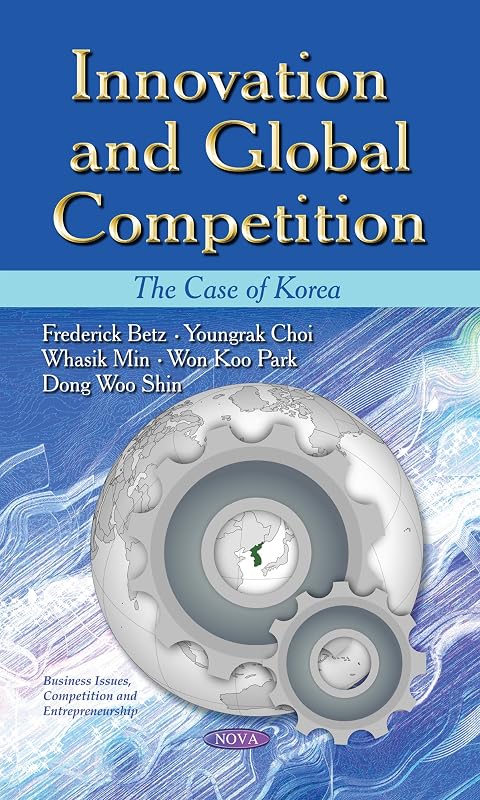
Innovation and Global Competition: The Case of Korea (Business Issues, Competition and Entrepreneurship) by Frederick Betz

Innovation and Global Competition: The Case of Korea (Business Issues, Competition and Entrepreneurship)

Frederick Betz
254 pages
Nova Science Pub Inc
Mar 2014
UK ed. Edition
Business & Investing WSBN
0
Readers
0
Reviews
0
Discussions
0
Quotes
Innovation continues to drive economic development and business competitiveness. In the past centuries, innovation has been focused around national and international business development. But in the twenty-first century, innovation is occurring in a global context, with the factors of innovation changing for success in global competitiveness. While many innovation theories abound, the real test of validity is an empirical success in using innovation to enter and succeed in global markets. While Japan was the principle success story for innovation and competitiveness in the second half of the twentieth century, Korea now has become the exemplar of global success. What strategies and factors have successful Korean firms implemented to achieve global stature? In 2012, Samsung became the largest electronics company in the world, dominating markets in memory semiconductors and displays and smart phones. Hyundai became the fifth largest automobile manufacturer in global markets. Posco had emerged from a national steel company into a global company. We review modern innovation theory and examine its practices in cases of successful Korean companies which have attained global stature. We will learn from the Korean experience in global competition, six important principles about the interaction between the economy and innovation: (1) a dynamic firm capability in both innovation and capital commitment, (2) an industrial economy-of-scale of innovative production capabilities (3) an industrial economy-of-speed in innovating new products, (4) a strong national research & development capability for advancing technology, (5) a strong national university system for developing educated human resources, and (6) a strong national infrastructure capability for fostering commercialisation of new business. Also, we learn that in the global marketplace for any competitive nation, there is no such thing as a 'post-industrial economy'.
Join the conversation

No discussions yet. Join BookLovers to start a discussion about this book!

No reviews yet. Join BookLovers to write the first review!

No quotes shared yet. Join BookLovers to share your favorite quotes!

Earn Points
Your voice matters. Every comment, review, and quote earns you reward points redeemable for Bitcoin.
Comment +5 pts Review +20 pts Quote +7 pts Upvote +1 pt
BookMatch Quiz
Find books similar to this one
About this book
Pages 254
Publisher Nova Science Pub Inc
Published 2014
Readers 0