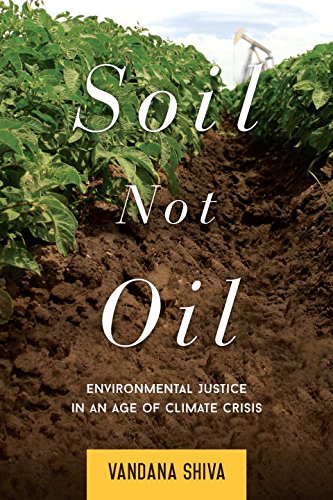
Soil Not Oil: Environmental Justice in an Age of Climate Crisis by Vandana Shiva

Soil Not Oil: Environmental Justice in an Age of Climate Crisis

Vandana Shiva
151 pages
North Atlantic Books, 2015.
Oct 2015
Outdoors & Nature WSBN
3
Readers
1
Reviews
0
Discussions
0
Quotes
In <i>Soil Not Oil</i>, Vandana Shiva explains that a world beyond dependence on fossil fuels and globalization is both possible and necessary. Condemning industrial agriculture as a recipe for ecological and economic disaster, Shiva champions the small, independent farm: their greater productivity, their greater potential for social justice as they put more resources into the hands of the poor, and the biodiversity that is inherent to the traditional farming practiced in small-scale agriculture. What we need most in a time of changing climates and millions who are hungry, she argues, is sustainable, biologically diverse farms that are more resistant to disease, drought, and flood. &quot;The solution to climate change,&quot; she observes, &quot;and the solution to poverty are the same.&quot; <i>Soil Not Oil</i> proposes a solution based on self-organization, sustainability, and community rather than corporate power and profits.
Join the conversation

No discussions yet. Join BookLovers to start a discussion about this book!

A Radical Solution to Save Humanity from Extinction...

This unforgettable book presents a no-nonsense analysis of the results of mechanization and industrialization on people, plants, and the soil, resulting in a three-pronged crisis threatening the survival of humanity. In four beautifully succinct chapters, Shiva describes how these challenges are not only intertwined but are the result of the same inaccurate business assumptions. Woven into each chapter, Vandana Shiva provides threads suggesting a plan for an extreme lifestyle "makeover" for humanity, one which will address all three challenges simultaneously, yet which would probably be unacceptable to most people in the Global North. This book is a "wake-up call" to humanity! Vandana Shiva begins by describing three emergencies, life-threatening crises that humanity faces today. We all know about peak oil and climate change, as they are regularly covered by the media. The third emergency is food insecurity, which Shiva describes as interconnected and intertwined with the other two crises. Shiva describes a food crisis as caused by "the combined impacts of the industrialization and globalization of agriculture" . Stepping back through history, Vandana Shiva reminds us that industrialization and later globalization of manufacturing - which were only possible with cheap and plentiful fossil fuels - have triggered climate change and peak oil. But what was the mindset that launched mechanization and later globalization? It is here that Shiva really takes off, explaining how the term "development" is used in biology versus economics, and how development serves to oppress people and degrade the earth's natural infrastructure today. Woven throughout these chapters are hints to Shiva's preferred solution. Replace cap-and-trade with a carbon tax and limit the amounts of pollution allowed. Replace cars with camels, cows, donkeys, horses, oxen, and buffalo. The animals provide draft energy, plus food and fertilizer, and jobs for blacksmiths, leather artisans, and veterinari...

No quotes shared yet. Join BookLovers to share your favorite quotes!

Earn Points
Your voice matters. Every comment, review, and quote earns you reward points redeemable for Bitcoin.
Comment +5 pts Review +20 pts Quote +7 pts Upvote +1 pt
BookMatch Quiz
Find books similar to this one
About this book
Pages 151
Publisher North Atlantic Books...
Published 2015
Readers 3