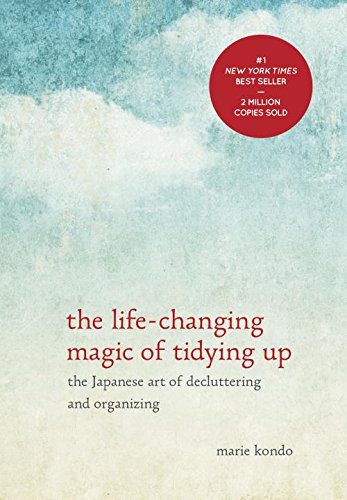
The Life-Changing Magic of Tidying Up: The Japanese Art of Decluttering and Organizing by Marie Kondō
The Life-Changing Magic of Tidying Up: The Japanese Art of Decluttering and Organizing
Marie Kondō
224 pages
Ten Speed Press
Oct 2014
Hardcover
WSBN
22
Readers
1
Reviews
0
Discussions
3
Quotes
This New York Times best-selling guide to decluttering your home from Japanese cleaning consultant Marie Kondo takes readers step-by-step through her revolutionary KonMari Method for simplifying organizing and storingDespite constant efforts to declutter your home do papers still accumulate like snowdrifts and clothes pile up like a tangled mess of noodlesJapanese cleaning consultant Marie Kondo takes tidying to a whole new level promising that if you properly simplify and organize your home once yoursquoll never have to do it again Most methods advocate a room-by-room or little-by-little approach which doom you to pick away at your piles of stuff forever The KonMari Method with its revolutionary category-by-category system leads to lasting results In fact none of Kondorsquos clients have lapsed and she still has a three-month waiting list With detailed guidance for determining which items in your house ldquospark joyrdquo and which donrsquot this international bestseller featuring Tokyorsquos newest lifestyle phenomenon will help you clear your clutter and enjoy the unique magic of a tidy homemdashand the calm motivated mindset it can inspire.

No discussions yet. Join BookLovers to start a discussion about this book!

Mindful decluttering

I adore this book. I first heard about this method on message boards online. Everyone was talking about it. At first I started going through some of the advice from her book second hand, but eventually I got caught up enough in a decluttering whirlwind that I decided to buy the book (ebook format of course!). I'm really glad I did! It's a very fast read and does tend to repeat itself at times (I think there may be some awkwardness from translation) but well worth the read through. I love that in the book she tells about her own journey involved in developing her method. We see the places she stumbled and get to learn from her experience. Marie Kondo seems to have stumbled upon a lot of concepts that have been heavily researched in the social sciences sciences without knowing about the evidence base form them, just drawing from her own experiences. To me this method maps on conceptually to the concept of mindfulness although the book never uses the word "mindfulness". (Buddhist scholars forgive me here, as I am going to talk about mindfulness from a western psychological research perspective rather than a religious one since that is that area I am familiar with.) Kondo instructs people to attend to their present moment feelings as they hold each object. Even when discarding objects it is done so in a way that expresses gratitude an acceptance for all experiences the objects brought both positive and negative. Did you love this object in the past, but now it is worn out? Taking Kondo's advice of thanking each object for the role it had before discarding it may seem a little silly, but it works. It creates a context in which removing the object from your life is not about you expressing hatred for the object, rather it is acknowledging that it has served it's purpose and can move on. This makes it easier to discard objects like that dress you used to wear all the time and loved, but now has a stain on it. In Kondo's method discarding is not about you waging a battle...

Keep only those things that speak to your heart. Then take the plunge and discard all the rest. By doing this, you can reset your life and embark on a new lifestyle.
No matter how wonderful things used to be, we cannot live in the past. The joy and excitement we feel here and now are more important.
There’s no need to finish reading books that you only got halfway through. Their purpose was to be read halfway.