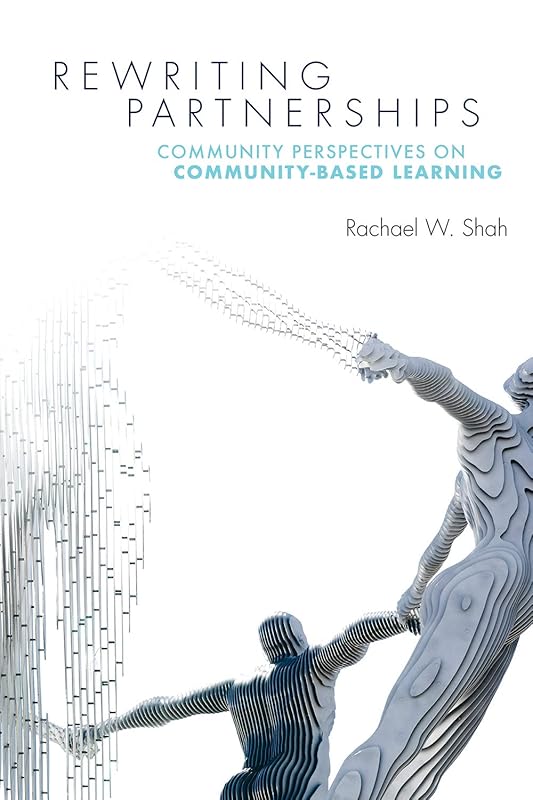
Rewriting Partnerships: Community Perspectives on Community-Based Learning by Rachael W. Shah

Rewriting Partnerships: Community Perspectives on Community-Based Learning

Rachael W. Shah
232 pages
Utah State University Press
May 2020
Paperback
Professional & Technical WSBN
0
Readers
0
Reviews
0
Discussions
0
Quotes
Winner of the IARSLCE 2021 Publication of the Year Award and the Coalition for Community Writing Outstanding Book Award.Community members are rarely tapped for their insights on engaged teaching and research, but without these perspectives, it is difficult to create ethical and effective practices. Rewriting Partnerships calls for a radical reorientation to the knowledges of community partners. Emphasizing the voices of community members themselves - the adult literacy learners, secondary students, and youth activists who work with college students - the book introduces Critical Community-Based Epistemologies, a deeply practical approach to knowledge construction that centers the perspectives of marginalized participants. Drawing on interviews with over eighty community members, Rewriting Partnerships features community knowledges in three common types of community-engaged learning: youth working with college students in a writing exchange program, nonprofit staff who serve as clients for student projects, and community members who work with graduate students. Interviewees from each type of partnership offer practical strategies for creating more ethical collaborations, including how programs are built, how projects are introduced to partners, and how graduate students are educated. The book also explores three approaches to partnership design that create space for community voices at the structural level: advisory boards, participatory evaluation, and community grading. Immediately applicable to teachers, researchers, community partners, and administrators involved in community engagement, Rewriting Partnerships offers concrete strategies for creating more community-responsive partnerships at the classroom level as well as at the level of program and research design. But most provocatively, the book challenges common assumptions about who can create knowledge about community-based learning, demonstrating that community partners have the potential to contribute significantly to community engagement scholarship and program decision-making.
Join the conversation

No discussions yet. Join BookLovers to start a discussion about this book!

No reviews yet. Join BookLovers to write the first review!

No quotes shared yet. Join BookLovers to share your favorite quotes!

Earn Points
Your voice matters. Every comment, review, and quote earns you reward points redeemable for Bitcoin.
Comment +5 pts Review +20 pts Quote +7 pts Upvote +1 pt
BookMatch Quiz
Find books similar to this one
About this book
Pages 232
Publisher Utah State Universit...
Published 2020
Readers 0