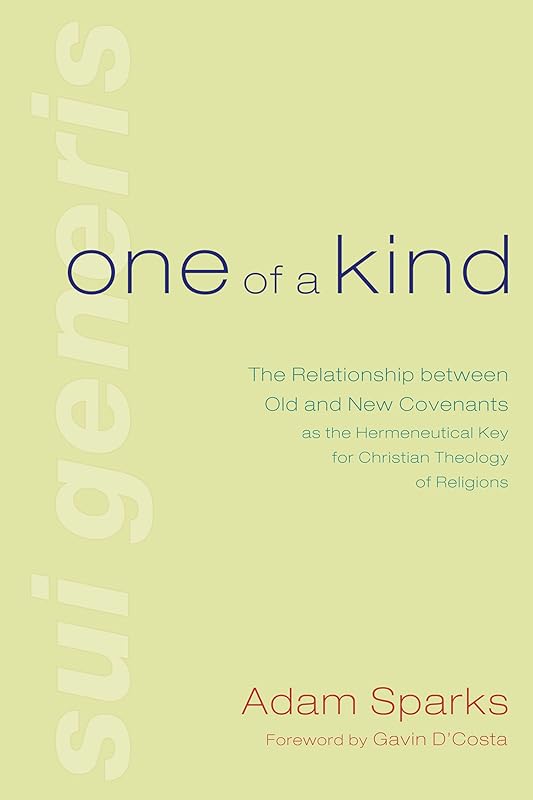
One of a Kind: The Relationship between Old and New Covenants as the Hermeneutical Key for Christian Theology of Religions by Adam Sparks

One of a Kind: The Relationship between Old and New Covenants as the Hermeneutical Key for Christian Theology of Religions

Adam Sparks
354 pages
Pickwick Publications, an Imprint of Wipf and Stock Publishers
Jan 2010
Paperback
Religion & Spirituality WSBN
0
Readers
0
Reviews
0
Discussions
0
Quotes
A fundamental requirement in an inclusivist understanding of the relationship between Christianity and other religions is evidence of God's salvific activity outside any knowledge of Christ. This is commonly identified in the religion of Old Testament Israel. On this basis an analogy (the "Israel analogy") is drawn between the religion of the old covenant and contemporary non-Christian religions. Closely related is the parallel argument that as Christ has fulfilled the Old covenant, he can also be seen as the fulfillment of other religious traditions and their scriptures.. This study outlines the use of the Israel analogy and the fulfillment model, subjecting these concepts to a biblical and theological critique revealing that the exegetical and patristic data are misconstrued in support of these concepts. Furthermore, the Israel analogy and the fulfillment model undermine the sui generis relationship between the old and new covenants and fail to respect the organic, progressive nature of salvation history. They also misconstrue the old covenant and the nature of its fulfillment in the new covenant. . The Israel analogy and fulfillment model rely on a correspondence between the chronologically premessianic (Israel) and the epistemologically premessianic (other religions) , and therefore consider the "BC condition" to continue today. In so doing, they undermine the significance of the Christ-event by failing to appreciate the decisive effect of this event on history and the nature of existence. It marks a radical turn in salvation history, a crisis point, rendering the BC period complete and fulfilled. Therefore the concept of a continuing "premessianic" condition or state is seriously flawed, as are the Israel analogy and fulfillment model. Thus the inclusivist paradigm reliant in large part on these defective concepts is also problematic, and proponents of this paradigm need to reconsider its basis.. "Within the Christian theology of religions, the 'Israel analogy' or 'fulfilment paradigm,' albeit in differing tradition-specific forms, is often believed to be indisputable evidence which clinches the case for some version of 'inclusivism.' In this important and comprehensive study, Sparks puts this evidence under the microscope of biblical and systematic theology, and shows it to be fundamentally inadmissible." --Daniel Strange, Oak Hill Theological College, London. . "This important book presents a serious challenge to the prevailing inclusivist understanding of the relationship between Christianity and other faiths. The author brings post-supersessionist readings of Scripture and tradition into the broader field of 'theology of religions' in an original formulation that will have to be taken seriously by anyone concerned with interfaith relations, Jewish-Christian dialogue, and a deeper understanding of the uniqueness of Christ."--Richard Harvey, allnations, UK. Adam Sparks is a sessional lecturer (Christian theology and other religions) at Birkbeck College (University of London) and Secretary of "Theology for All" (TFA) .
Join the conversation

No discussions yet. Join BookLovers to start a discussion about this book!

No reviews yet. Join BookLovers to write the first review!

No quotes shared yet. Join BookLovers to share your favorite quotes!

Earn Points
Your voice matters. Every comment, review, and quote earns you reward points redeemable for Bitcoin.
Comment +5 pts Review +20 pts Quote +7 pts Upvote +1 pt
BookMatch Quiz
Find books similar to this one
About this book
Pages 354
Publisher Pickwick Publication...
Published 2010
Readers 0