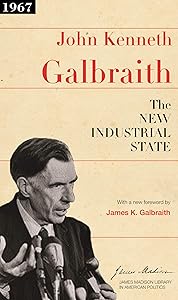



Galbraith: The Affluent Society by John Kenneth Galbraith

Galbraith: The Affluent Society

John Kenneth Galbraith
1098 pages
Library of America
Sep 2010
Hardcover
Business & Investing WSBN
0
Readers
0
Reviews
0
Discussions
0
Quotes
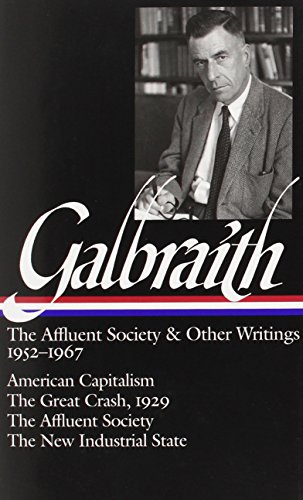
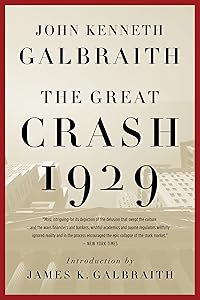
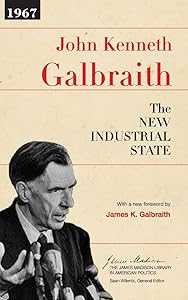
Incisive and original, John Kenneth Galbraith wrote with an eloquence that burst the conventions of his discipline and won a readership none of his fellow economists could match. This Library of America volume, the first devoted to economics, gathers four of his key early works, the books that established him as one of the leading public intellectuals of the last century. <br><br>In <i>American Capitalism</i>, Galbraith exposes with great panache the myth of American free-market competition. The idea that an impersonal market sets prices and wages, and maintains balance between supply and demand, remained so vital in American economic thought, Galbraith argued, because oligopolistic American businessmen never acknowledged their collective power. Also overlooked was the way that groups such as unions and regulatory agencies react to large oligopolies by exerting countervailing power - a concept that was the book's lasting contribution. <br><br><i>The Great Crash, 1929</i> offers a gripping account of the most legendary (and thus misunderstood) financial collapse in American history, as well as an inquiry into why it led to sustained depression. Galbraith posits five reasons: unusually high income inequality; a bad, overleveraged corporate structure; an unsound banking system; unbalanced foreign trade; and, finally, &quot;the poor state of economic intelligence.&quot; His account is a trenchant analysis of the 1929 crisis and a cautionary tale of ignorance and hubris among stock-market players; not surprisingly, the book was again a bestseller in the wake of the 2008 economic collapse. <br><br>In <i>The Affluent Society</i>, the book that introduced the phrase &quot;the conventional wisdom&quot; into the American lexicon, Galbraith takes on a shibboleth of free-market conservatives and Keynesian liberals alike: the paramount importance of production. For Galbraith, the American mania for production continued even in an era of unprecedented affluence, when the basic needs of all but an impoverished minority had easily been met. Thus the creation of new and spurious needs through advertising - leading to skyrocketing consumer debt, and eventually a private sector that is glutted at the expense of a starved public sector. <br><br><i>The New Industrial State</i> stands as the most developed exposition of Galbraith's major themes. Examining the giant postwar corporations, Galbraith argued that the &quot;technostructure&quot; necessary for such vast organizations - comprising specialists in operations, marketing, and R&amp;D - is primarily concerned with reducing risk, not with maximizing profits; it perpetuates stability through &quot;the planning system.&quot; The book concludes with a prescient analysis of the &quot;educational and scientific estate,&quot; which prefigures the &quot;information economy&quot; that has emerged since the book was published.
Join the conversation

No discussions yet. Join BookLovers to start a discussion about this book!

No reviews yet. Join BookLovers to write the first review!

No quotes shared yet. Join BookLovers to share your favorite quotes!

Earn Points
Your voice matters. Every comment, review, and quote earns you reward points redeemable for Bitcoin.
Comment +5 pts Review +20 pts Quote +7 pts Upvote +1 pt
BookMatch Quiz
Find books similar to this one
About this book
Pages 1098
Publisher Library of America
Published 2010
Readers 0