The Fate of the Artist
Eddie Campbell
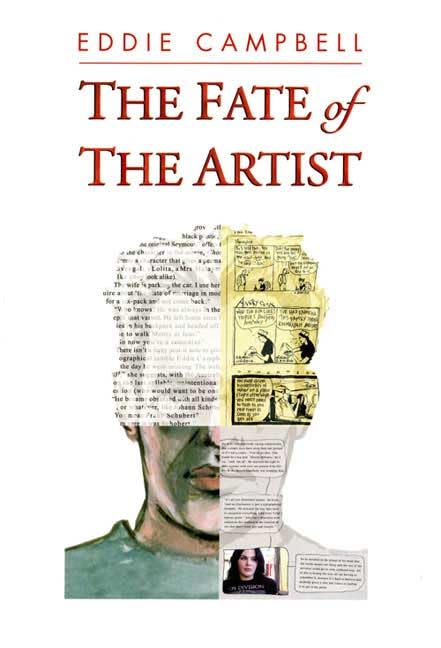
In this psuedo autobiography, the subject of the memoir has vanished without a trace.A master comics artist, here Eddie Campbell offers a complex, caustic and surprising meditation on balancing the lonely life of the artist with the demands of everyday life. Read more Continue reading Read less FROM PUBLISHERS WEEKLY
Starred Review. Campbell, best known for his work on From Hell and his autobiographical Alec comics, has come up with a marvelous sui generis oddity: a meta-memoir about his own disappearance that's a kind of intently controlled nervous breakdown on paper. It's a nonlinear, mixed-media collage of a book - there are typeset prose passages, painted comics about his family, old-fashioned newspaper strips, photos with typeset word balloons, a child's crayon scrawl representing God and, near the end, an illustrated adaptation of O. Henry's story "The Confessions of a Humorist," which concerns how habitually turning life into art can make life unbearable. Campbell's always been interested in the curious nooks of history, and there's a running thread about artistic also-rans like Johann Schobert and the Greek sculptor Phidias; there's also an ongoing gag about Campbell replacing himself with an imaginary actor named Richard Siegrist. The tone is whimsical and playful, but there's a deep despair beneath it - about drinking, burnout and what happens to an artist "when his imaginary friends [stop] calling" - that overwhelms and takes the place of the plot. What pulls the whole thing together is Campbell's stunningly protean visual technique: fierce blotches of watercolor, scraggly pen-and-ink work and whiplash stylistic shifts from impressionistic caricatures to exquisitely rendered painterly miniatures. (Apr.)
Copyright Reed Business Information, a division of Reed Elsevier Inc. All rights reserved. FROM SCHOOL LIBRARY JOURNAL
Grade 10 Up-Campbell has penned a postmodern volume about an investigation into his own mysterious disappearance. The gorgeously produced pages blend photographs, type, real and fake comic strips, autobiographical anecdotes, and musings about the nature of fiction and humor into a marvelous rumination on writerly inspiration and family dynamics. Portions of the story are told from the perspective of Campbells family members, who-like the author-are also rendered as various semi-fictions, mostly in the form of the mock comic strips that stud the narrative. The technical production of this book and the risks the author has taken in expanding his visual vocabulary and storytelling techniques are great fun, but the investigation sequence ultimately disappoints. However, Campbells continuing conversations about the nature and possibilities of sequential art are as enjoyable as they are effectively rendered. The volume ends with an interpretation of O. Henrys The Confessions of a Humorist, with Campbell casting himself as the storys protagonist. This does an excellent job of summing up or echoing many of the concepts about fiction and funnies that Campbell explores in the previous pages. It is also an artful adaptation and a satisfying and coherent close to the scattered but well-intentioned series of musings that precede it. Charming and beautiful, the book might just be slightly too rarefied and abstract for average readers, but it is a superlative example of the scope and potential of the form.-Benjamin Russell, The Derryfield School, Manchester, NH
Copyright Reed Business Information, a division of Reed Elsevier Inc. All rights reserved. FROM BOOKLIST
*Starred Review* Campbell has been chronicling his life in comics stories since his days as a pub-crawling young reprobate 25 years ago. Recent installments of his ongoing autobiography have drolly depicted the difficulty of creating art, particularly in a field as culturally and financially marginal as comics. Here he purports to address the fate of the artist in the form of an investigation into his own sudden disappearance. The probe is depicted through a multimedia melange that encompasses a hard-boiled detective story, a fumetti (photo-comics story) in which Campbell's daughter reminisces about her missing father, and yellowed old faux newspaper comic strips depicting the domestic travails of Campbell and his long-suffering wife. All a means for the artist to air his midlife crisis, perhaps, but the spine of the book is Campbell's lovely, deceptively casual, color wash drawings. Not to give anything away, but the corpus delicti is found in the State Reference Library under 741.5, "the number recently assigned to graphic novels by the Dewey decimal system" to keep them away from the "works of true literary merit in the 800s." Playful and wise, Campbell's latest report from the art front continues to demonstrate his mastery of the comics medium. Gordon Flagg
Copyright American Library Association. All rights reserved FROM THE INSIDE FLAP
In Eddie Campbell's latest graphic novel, the author will conduct an investigation into his own sudden disappearance.In wildly comical reenactments of incidents from his curious life, his part will be played by an actor.In this creative mining of the rich resources from the comic strip language Campbell will give us a complex meditation on the lonely demands of art amid the realities of everyday life. ABOUT THE AUTHOR
Eddie Campbell is the acclaimed artist behind From Hell which he won the Ignatz Award for Outstanding Graphic novel and the Eisner award for Best Graphic Album. Campbell is also the author of the series Bachus and Alec: The King Canute Crowd
Eddie Campbell is the acclaimed artist behind From Hell, for which he won the Ignatz award for Outstanding Graphic Novel and the Eisner award for Best Graphic Album. In 2001, From Hell was made into a major motion picture starring Johnny Depp. Campbell is also the creator of the series Bacchus and Alec: The King Canute Crowd.
Read more Continue reading Read less