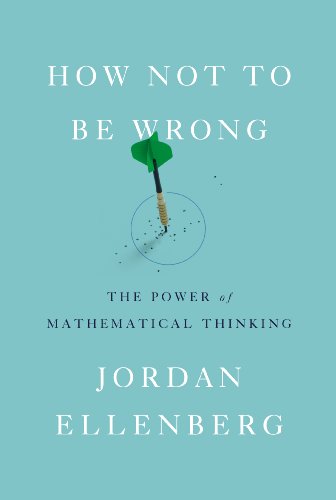
The Freakonomics of math--a math-world superstar unveils the hidden beauty and logic of the world and puts its power in our handsThe math we learn in school can seem like a dull set of rules, laid down by the ancients and not to be questioned. In How Not to Be Wrong, Jordan Ellenberg shows us how terribly limiting this view is: Math isn't confined to abstract incidents that never occur in real life, but rather touches everything we do--the whole world is shot through with it.Math allows us to see the hidden structures underneath the messy and chaotic surface of our world. It's a science of not being wrong, hammered out by centuries of hard work and argument. Armed with the tools of mathematics, we can see through to the true meaning of information we take for granted: How early should you get to the airport? What does "public opinion" really represent? Why do tall parents have shorter children? Who really won Florida in 2000? And how likely are you, really, to develop cancer?How Not to Be Wrong presents the surprising revelations behind all of these questions and many more, using the mathematician's method of analyzing life and exposing the hard-won insights of the academic community to the layman--minus the jargon.
No discussions yet. Join BookLovers to start a discussion about this book!
An Acquired Taste, So Don't Give Up Too Soon!
You'll start reading this book thinking there will be a lot of juicy math on odds vs. utility functions in decision theory, then toss it out in disgust when you find you're reading a snail-paced "lives of the Saints in Probability..." BUT IF you toss it, you'd be WRONG just like the book's title! Ok, I'm with George Box that all models are wrong but some are useful, so in all humility, even if our thinking is n-dimensional and nonlinear, our headlights still don't go out centuries, and the law of unintended consequences will inevitably rear it's fearsome head. So yes, I know I'm gunna be wrong more than right even reading this gem of a book. It gets FUN! As you read on, Jord gets into deeper and deeper math, and most significantly, starts to COMBINE stats, geometry, differential equations, etc. in eclectic, multi-disciplinary fields, which are much more like real life than academic exercises. It is not only math that has a new twist every hour these days, it is the combinations of fields (as in vocations and disciplines, not quantum fields) that is making math more and more relevant. I'm not one to discount the gut, heart, tradition or even intuition, but it really is enlightening to take a little more quant view at our normal evaluations of everyday spin. Yes, the author does have a bit of a left bent, but heck, those are just examples, and you'd have to be pretty emotion driven not to see how easily his logic applies to ANY "position." I see a LOT of tongue in cheek in this book and a LOT of both wonder and just plain great story telling-- please don't pass on this book if you're bright but not necessarily a policy wonk! I've been in school board meetings where one group or another wants to add social justice at the expense of STEM and math, and I just scratch my head. I've seen left proposals to take out intelligent design while adding Islam (??) and right proposals to remove Islam, Darwin and Linear Algebra to add family social values. Hmmm. The folks that cr...
No quotes shared yet. Join BookLovers to share your favorite quotes!
Earn Points
Your voice matters. Every comment, review, and quote earns you reward points redeemable for Bitcoin.