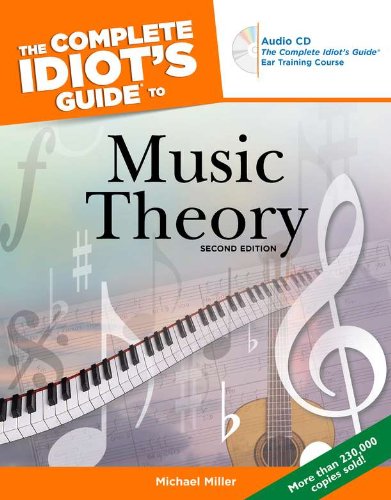


The Complete Idiot's Guide to Music Theory, 2nd Edition by Michael Miller

The Complete Idiot's Guide to Music Theory, 2nd Edition

Michael Miller
314 pages
Alpha
Sep 2005
Reference WSBN
3
Readers
1
Reviews
0
Discussions
0
Quotes
<b><i>A music theory book that hits the high note ... </i></b> <p> This updated and expanded edition of <i>The Complete Idiot's Guide® to Music Theory</i> breaks down a difficult subject in a simple way - even for those who think they have no rhythm or consider themselves tone deaf. With clear, concise language, it explains everything from bass-clef basics to confusing codas. This new edition includes:<br> -A brand-new CD<br> -A comprehensive ear-training section<br> -Musical examples of intervals, scales, chords, and rhythms<br> -Aural exercises so readers can test their ear training and transcription skills<br></p>

No discussions yet. Join BookLovers to start a discussion about this book!

Great accessible guide to music theory - especially for the beginner

My background is in engineering and computer science. However, I do a lot of multimedia programming, and when it came to writing code for computer music I was at a loss because I have no formal musical training whatsoever. I've never played an instrument and I probably never will. However, I found it disabling to be unable to read music or understand the language of music theory when it came to reading the many helpful works on computer music that are in print and on the web. This book appeared to be what I was looking for and it turned out I was correct in my choice. It takes you from the absolute beginning, assuming you can't even read music, and takes you from intervals through phrases through counterpoint and into composition and performance. There are very helpful exercises at the end of every chapter with solutions at the end of the book, making this a good choice as a textbook or an excellent and inexpensive means of self study. Part one talks about the notes of a scale,the different types of clefs and staves, the intervals between notes, major and minor scales, and keys and key signatures. Part two, on rhythm, starts by teaching you what simple whole notes are and moves on to sixteenth notes and syncopations. Also covered are time signatures, tempo and dynamics, and how to navigate through a piece of music. In part three, Tunes, you learn how to put tones and rhythms together to create a melody. Next you learn how to add chords to your tunes and find out about chord progressions and song forms. At this point, you have what you need to create your own pieces of music. Part 4, on accompaniment, teaches you how to train your ears so you can write down music as you hear it. You'll be able to create simple accompaniment parts on piano or guitar. Last, this section shows you how to take a song in one key and transpose it to a totally different key. Part 5, on embellishment, shows how to fill out your music with harmonies and counterpount, and how to add fancy c...

No quotes shared yet. Join BookLovers to share your favorite quotes!