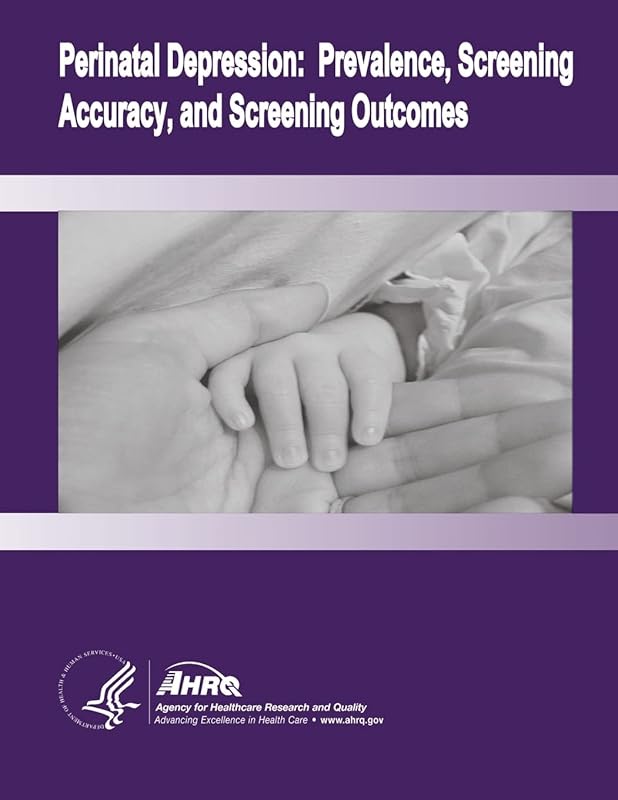
Perinatal Depression: Prevalence, Screening Accuracy, and Screening Outcomes: Evidence Report/Technology Assessment Number 119 by U.S. Department of Health and Human Services

Perinatal Depression: Prevalence, Screening Accuracy, and Screening Outcomes: Evidence Report/Technology Assessment Number 119

U.S. Department of Health and Human Services
236 pages
CreateSpace Independent Publishing Platform
May 2014
Paperback
Health, Mind & Body WSBN
0
Readers
0
Reviews
0
Discussions
0
Quotes
Depression is the leading cause of disease-related disability among women. In particular, women of childbearing age are at high risk for major depression. Pregnancy and new motherhood may increase the risk of depressive episodes. Depression during the perinatal period can have devastating consequences, not only for the women experiencing it but also for the women's children and family. Perinatal depression encompasses major and minor depressive episodes that occur either during pregnancy or within the first 12 months following delivery. When referring to depression in this population, researchers and clinicians frequently have not been clear about whether they are referring to major depression alone or to both major and minor depression. Major depression is a distinct clinical syndrome for which treatment is clearly indicated, whereas the definition and management of minor depression are less clear. In this report, we refer to major depression alone by identifying it discretely as major depression. Minor depression is an impairing, yet less severe, constellation of depressive symptoms for which controlled trials have not consistently indicated whether or not particular interventions are more effective than placebo. In this report, we refer to this grouping as major or minor depression or by the more general terms "depression" or "depressive illness." Perinatal depression, whether one is referring to major depression alone or to either major or minor depression, often goes unrecognized because many of the discomforts of pregnancy and the puerperium are similar to symptoms of depression. Another mental disorder that can occur in the perinatal period is postpartum psychosis. Unlike postpartum depression, postpartum psychosis is a relatively rare event with a range of estimated incidence of 1.1 to 4.0 cases per 1,000 deliveries. The onset of postpartum psychosis is usually acute, within the first 2 weeks of delivery, and appears to be more common in women with a strong family history of bipolar or schizoaffective disorder. This review addresses the prevalence and incidence of perinatal depression, the accuracy of screening instruments for perinatal depression, and the effectiveness of interventions for women screened as high risk for developing perinatal depression. The three key questions (KQs) are: 1. What are the incidence and prevalence of depression (major and minor) during pregnancy and during the postpartum period? Are they increased during pregnancy and the postpartum period compared to non-childbearing periods? 2. What is the accuracy of different screening tools for detecting depression during pregnancy and the postpartum period? 3. Does prenatal or early postnatal screening for depressive symptoms with subsequent intervention lead to improved outcomes?
Join the conversation

No discussions yet. Join BookLovers to start a discussion about this book!

No reviews yet. Join BookLovers to write the first review!

No quotes shared yet. Join BookLovers to share your favorite quotes!

Earn Points
Your voice matters. Every comment, review, and quote earns you reward points redeemable for Bitcoin.
Comment +5 pts Review +20 pts Quote +7 pts Upvote +1 pt
BookMatch Quiz
Find books similar to this one
About this book
Pages 236
Publisher CreateSpace Independ...
Published 2014
Readers 0