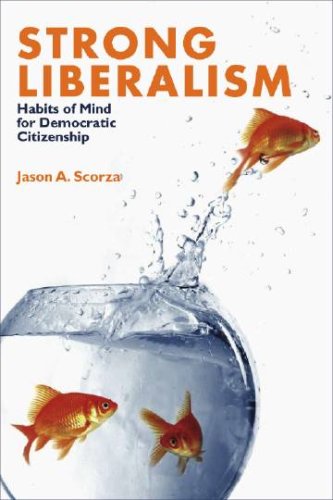
Strong Liberalism: Habits of Mind for Democratic Citizenship (Civil Society: Historical and Contemporary Perspectives) by Jason A. Scorza

Strong Liberalism: Habits of Mind for Democratic Citizenship (Civil Society: Historical and Contemporary Perspectives)

Jason A. Scorza
270 pages
Tufts Univ
Jan 2007
Hardcover
Politics WSBN
0
Readers
0
Reviews
0
Discussions
0
Quotes

Free account. We’ll keep this book ready while you join.

Find a copy

Formats and availability vary by store. As an Amazon Associate I earn from qualifying purchases.

In this age of "total" war on terrorism, many liberals fail to recognize the dangers of adopting the methods of their enemies--of meeting propaganda with propaganda, cruelty with cruelty, and violence with violence. Other liberals reject even modest efforts to teach and regulate good citizenship, fearing that in doing so they will come to resemble their enemies. Can liberal democracy be strengthened and secured without either compromising basic liberal principles or emasculating fundamental liberal purposes? The great totalitarian regimes of the twentieth century are gone, but the need for "strong liberalism" has never been more urgent. Jason A. Scorza argues that liberalism can generate an account of citizenship responsive to such pressing contemporary challenges as political fear, political apathy, and conformist political membership. Strong Liberalism is founded on understanding thoroughly the canonical defenders of liberal democracy (John Stuart Mill, John Rawls, and Judith Shklar) , moving beyond the thinking of prominent contemporary theorists (Stephen Macedo, William Galston, and Thomas Spragens) , and parrying the arguments of liberalism's critics (Benjamin Barber, Michael Sandel, and Mary Ann Glendon) . Scorza imparts a sharp theory of "strong liberalism" that summons liberal philosophy to the battlefield of the inner life of politics and recalls it to its own essential but often overlooked strengths: civic friendship, political courage, political self-reliance, civic toleration, and political irreverence. The theory of strong liberalism accepts that civic strength is rooted in civic pluralism. Liberal democracy is best served by the cultivation of multiple examples of good citizenship rather than by the insistence that a single, ideal civic character can be identified and universally imposed through civic education.
Join the conversation

No discussions yet. Join BookLovers to start a discussion about this book!

No reviews yet. Join BookLovers to write the first review!

No quotes shared yet. Join BookLovers to share your favorite quotes!

Earn Points
Your voice matters. Every comment, review, and quote earns you reward points redeemable for Bitcoin.
Comment +5 pts Review +20 pts Quote +7 pts Upvote +1 pt
Similar Books
Find books similar to this one
About this book
Pages 270
Publisher Tufts Univ
Published 2007
Readers 0