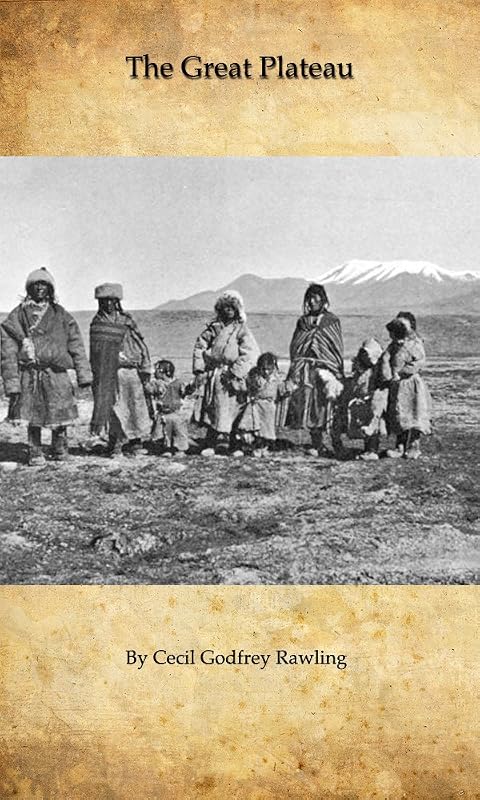
The Great Plateau: Being an Account of Exploration in Central Tibet, 1903, and of the Gartok Expedition, 1904-1905 by Cecil Rawling

The Great Plateau: Being an Account of Exploration in Central Tibet, 1903, and of the Gartok Expedition, 1904-1905

Cecil Rawling
326 pages
Jan 2005
Hardcover
History WSBN
0
Readers
0
Reviews
0
Discussions
0
Quotes

Free account. We’ll keep this book ready while you join.

Find a copy

Formats and availability vary by store. As an Amazon Associate I earn from qualifying purchases.

The ancient history of Tibet is practically unknown. Neither in its monasteries nor in its temples have records been discovered which throw any light on its rulers or its people. Inhabited it must have been, as it lay contiguous to the powerful kingdom of China, with its teeming population and commercial wealth. Marvellous indeed must have been the earliest journeys made by Europeans, for it is known that between the sixth and eleventh centuries Nestorian and Armenian missionaries penetrated far into the country in their efforts to propagate the Christian religion. No accounts of their travels, however, are now in existence, and it was not until 1626 that the Portuguese, Antonio de Andrade, mentions in a letter, dated August 15th of that year, that he had crossed the Himalayas and visited Tsaparang, on the head-waters of the Sutlej. An event of far greater importance was, however, near at hand, for the accounts of Johann Grueber, an Austrian of the Jesuit Order, and of Albert D'Orville, a Belgian, show that these adventurous priests visited Lhasa in 1662. At various intervals other European missionaries entered Tibet, but none were more successful than the Capuchin Friars, who not only travelled to Lhasa but settled there in 1708. Scanty records have been left by these early adventurers, and the first clear account is furnished by Mr. G. Bogle, an Englishman who was sent into the country by Warren Hastings in 1774-75. He was followed by Lieutenant Turner in 1783, and in 1812 by Mr. Moorcroft, The latter reached Gartok, but was shortly afterwards murdered close by. No further travels of importance took place until 1846, when the famous Fathers Hue and Gabet entered Lhasa, and as a result of their journey gave to the world some delightful letters descriptive of the place.
Join the conversation

No discussions yet. Join BookLovers to start a discussion about this book!

No reviews yet. Join BookLovers to write the first review!

No quotes shared yet. Join BookLovers to share your favorite quotes!

Earn Points
Your voice matters. Every comment, review, and quote earns you reward points redeemable for Bitcoin.
Comment +5 pts Review +20 pts Quote +7 pts Upvote +1 pt
Similar Books
Find books similar to this one
About this book
Pages 326
Published 2005
Readers 0