Pogo: The Complete Daily & Sunday Comic Strips, Vol. 1: Through the Wild Blue Wonder by Walt Kelly

Pogo: The Complete Daily & Sunday Comic Strips, Vol. 1: Through the Wild Blue Wonder

Walt Kelly
289 pages
Fantagraphics Books
Dec 2011
Hardcover
Graphic Novels WSBN
3
Readers
1
Reviews
0
Discussions
0
Quotes
<p>The first volume of the second-most requested strip collection reprint in Fantagraphics' history.</p> Walt Kelly started his career at age 13 in Connecticut as a cartoonist and reporter for the Bridgeport Post. In 1935, he moved to Los Angeles and joined the Walt Disney Studio, where he worked on classic animated films, including Pinocchio, Dumbo, and Fantasia. Rather than take sides in a bitter labor strike, he moved back east in 1941 and began drawing comic books.<br><br> It was during this time that Kelly created Pogo Possum. The character first appeared in Animal Comics as a secondary player in the &quot;Albert the Alligator&quot; feature. It didn't take long until Pogo became the comic's leading character. After WWII, Kelly became artistic director at the New York Star, where he turned Pogo into a daily strip. By late 1949, Pogo appeared in hundreds of newspapers. Until his death in 1973, Kelly produced a feature that has become widely cherished among casual readers and aficionados alike.<br><br> Kelly blended nonsense language, poetry, and political and social satire to make Pogo an essential contribution to American &quot;intellectual&quot; comics. As the strip progressed, it became a hilarious platform for Kelly's scathing political views in which he skewered national bogeymen like J. Edgar Hoover, Joseph McCarthy, George Wallace, and Richard Nixon. Walt Kelly started when newspaper strips shied away from politics -- Pogo was ahead of its time and ahead of later strips (such as Doonesbury and The Boondocks) that tackled political issues. Our first (of 12) volume reprints approximately the first two years of Pogo -- dailies and (for the first time) full-color Sundays.<br><br> This first volume also introduces such enduring supporting characters as Porkypine, Churchy LaFemme, Beauregard Bugleboy, Seminole Sam, Howland Owl, and many others. And for Christmas, 1949, Kelly started his tradition of regaling his readers with his infamously and gloriously mangled Christmas carols.<br><br> Special features in this sumptuous premiere volume, which is produced with the full cooperation of Kelly's heirs, include a biographical introduction by Kelly biographer Steve Thompson, an extensive section by comics historian R. C. Harvey explaining some of the more obscure current references of the time, a foreword by legendary columnist Jimmy Breslin, and more. 32 pages of full-color and 320 pages of black-and-white comics

No discussions yet. Join BookLovers to start a discussion about this book!

It's about time ...

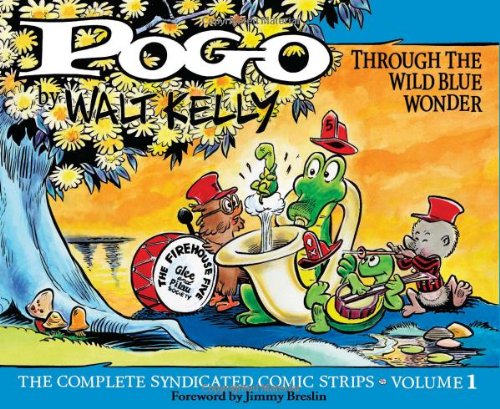
The first words in the Editor's Notes of Fantagraphic new Pogo compilation Through the Wild Blue Wonder are the same words uttered under the breath of Pogo fans for almost ten years: "It's about time." The first of what is intended to be a twelve part series has finally arrived. Kim Thompson and Walt Kelly's daughter Carolyn Kelly have taken the time to give Pogofiles the quality product that that the work deserves. For the first time both the daily and Sunday strips have found a home together. The first thing a reader will notice after the beautiful dust cover (drawn and colored by Carolyn Kelly) is that the binding of this book is superior to similar collections, most notably the catastrophe that was done to Calvin and Hobbs. This is a book that should weather more than an occasional journey back into the Okefenokee Swamp. Opening the book to the first few pages and the reader finds original drawings that are sketched first with blue pencil and then inked. Walt Kelly used the blue pencil for the early sketching of his strips because the color did not show when the strip was reproduced. The table of contents lovingly breaks the content down into weeks and explains the action in a way that specific strips can be quickly found. I had to smile when I saw the first week's description began with: "Pogo and Churchy go fishing." There was never a predicament throughout the run of the strip that could not be solved with a return to the Suwanee River, the only river that runs through the actual Okefenokee, for either a casual float or a communal fish fry. What is surprising here is the lack of political satire. The first year of Pogo in syndication was for the most part politically noncommittal. Kelly first dabbles into political satire in March 1950, almost a year into the syndicated run. Even this, as R. C. Harvey points out in a section named "Swamp Talk," was more puns and vaudeville than hard-hitting political satire. Kelly, like other cartoon artists at the time, a...

No quotes shared yet. Join BookLovers to share your favorite quotes!