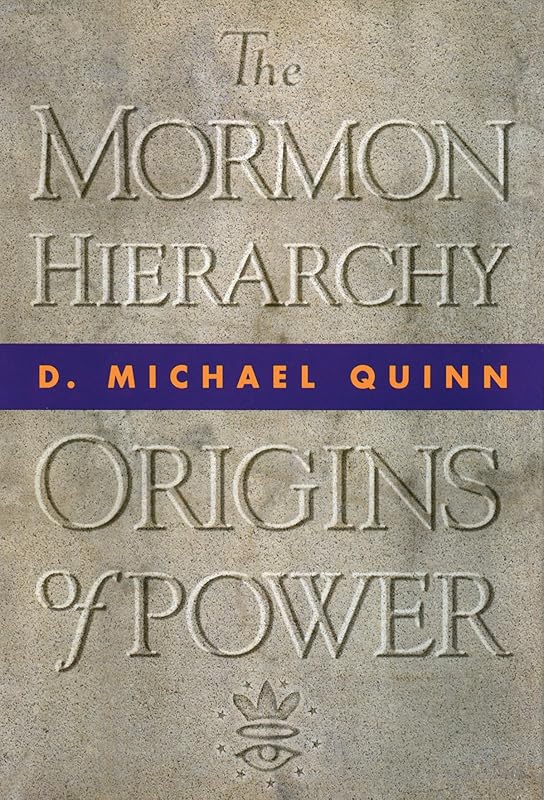
The Mormon Hierarchy: Origins of Power by D. Michael Quinn

The Mormon Hierarchy: Origins of Power

D. Michael Quinn
996 pages
Signature Books
Nov 2016
Hardcover
Religion & Spirituality WSBN
0
Readers
0
Reviews
0
Discussions
0
Quotes
Converts to Joseph Smith's 1828 restoration of primitive Christianity were attracted to the non-hierarchical nature of the movement. It was precisely because there were no priests, ordinances, or dogma that people joined in such numbers. Smith intended everyone to be a prophet, and anyone who felt called was invited to minister freely without formal office.

Not until seven years later did Mormons first learn that authority had been restored by angels or of the need for a hierarchy mirroring the Pauline model. That same year (1835) a Quorum of Twelve Apostles was organized, but their jurisdiction was limited to areas outside established stakes (dioceses) . Stakes were led by a president, who oversaw spiritual development, and by a bishop, who supervised temporal needs.

At Smith's martyrdom in 1844, the church had five leading quorums of authority. The most obvious successor to Smith, Illinois stake president William Marks, opposed the secret rites of polygamy, anointing, endowments, and the clandestine political activity that had characterized the church in Illinois. The secret Council of Fifty had recently ordained Smith as King on Earth and sent ambassadors abroad to form alliances against the United States.

The majority of church members knew nothing of these developments, but they followed Brigham Young, head of the Quorum of the Twelve, who spoke forcefully and moved decisively to eliminate contenders for the presidency. He continued to build on Smith's political and doctrinal innovations and social stratification. Young's twentieth-century legacy is a well-defined structure without the charismatic spontaneity or egalitarian chaos of the early church.

Historian D. Michael Quinn examines the contradictions and confusion of the first two tumultuous decades of LDS history. He demonstrates how events and doctrines were silently, retroactively inserted into the published form of scriptures and records to smooth out the stormy, haphazard development. The bureaucratization of Mormonism was inevitable, but the manner in which it occurred was unpredictable and will be, for readers, fascinating.
Join the conversation

No discussions yet. Join BookLovers to start a discussion about this book!

No reviews yet. Join BookLovers to write the first review!

No quotes shared yet. Join BookLovers to share your favorite quotes!

Earn Points
Your voice matters. Every comment, review, and quote earns you reward points redeemable for Bitcoin.
Comment +5 pts Review +20 pts Quote +7 pts Upvote +1 pt
BookMatch Quiz
Find books similar to this one
About this book
Pages 996
Publisher Signature Books
Published 2016
Readers 0