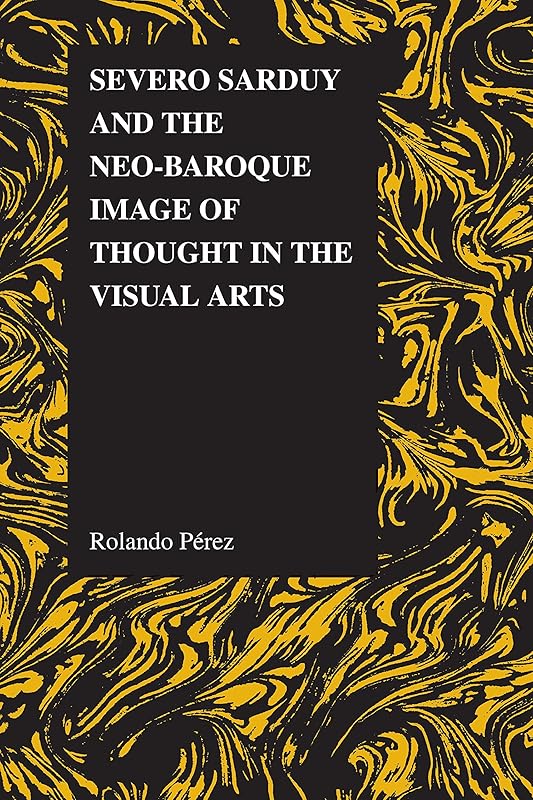
Severo Sarduy and the Neo-Baroque Image of Thought in the Visual Arts (Purdue Studies in Romance Literatures Book 53) by Rolando Pérez

Severo Sarduy and the Neo-Baroque Image of Thought in the Visual Arts (Purdue Studies in Romance Literatures Book 53)

Rolando Pérez
334 pages
Purdue University Press
Nov 2011
Hardcover
Default WSBN
0
Readers
0
Reviews
0
Discussions
0
Quotes
Severo Sarduy never enjoyed the same level of notoriety as did other Latin American writers like García Márquez and Vargas-Llosa, and his compatriot, Cabrera-Infante. On the other hand, he never lacked for excellent critical interpretations of his work from critics like Roberto González Echevarría, René Prieto, Gustavo Guerrero, and other reputable scholars. Missing, however, from what is otherwise an impressive body of critical commentary, is a study of the importance of painting and architecture, firstly, to his theory, and secondly, to his creative work. In order to fill this lacuna in Sarduy studies, Rolando Pérez's book undertakes a critical approach to Sarduy's essays - Barroco, Escrito sobre un cuerpo, "Barroco y neobarroco," and La simulación - from the stand point of art history. Often overlooked in Sarduy studies is the fact that the twenty-three-year-old Sarduy left Cuba for Paris in 1961 to study not literature but art history, earning the equivalent of a Master's Degree from the École du Louvre with a thesis on Roman art. And yet it was the art of the Italian Renaissance (e.g., the paintings as well as the brilliant and numerous treatises on linear perspective produced from the 15th to the 16th century) and what Sarduy called the Italian, Spanish, and colonial Baroque or "neo-baroque" visually based aesthetic that interested him and to which he dedicated so many pages. In short, no book on Sarduy until now has traced the multifaceted art historical background that informed the work of this challenging and exciting writer. And though Severo Sarduy and the Neo-Baroque Image of Thought in the Visual Arts is far from being an introduction, it will be a book that many a critic of Sarduy and the Latin American "baroque" will consult in years to come.
Join the conversation

No discussions yet. Join BookLovers to start a discussion about this book!

No reviews yet. Join BookLovers to write the first review!

No quotes shared yet. Join BookLovers to share your favorite quotes!

Earn Points
Your voice matters. Every comment, review, and quote earns you reward points redeemable for Bitcoin.
Comment +5 pts Review +20 pts Quote +7 pts Upvote +1 pt
BookMatch Quiz
Find books similar to this one
About this book
Pages 334
Publisher Purdue University Pr...
Published 2011
Readers 0