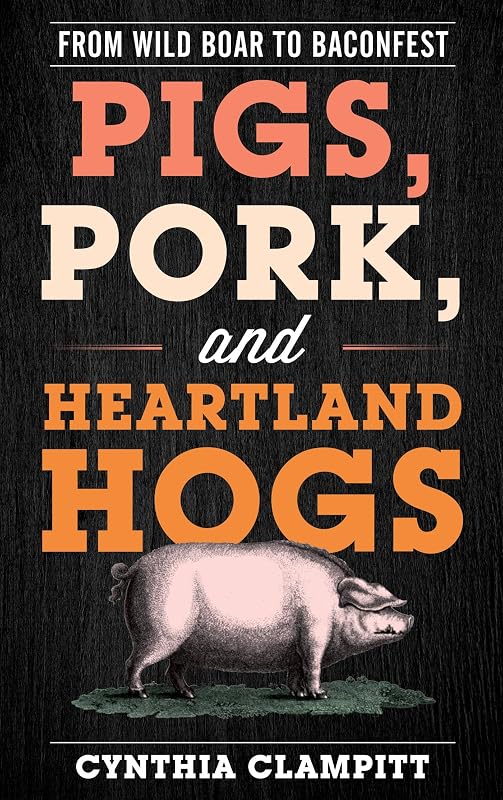
Among the first creatures to help humans attain the goal of having enough to eat was the pig, which provided not simply enough, but general abundance. Domesticated early and easily, herds grew at astonishing rates (only rabbits are more prolific) . Then, as people spread around the globe, pigs and traditions went with them, with pigs making themselves at home wherever explorers or settlers carried them. Today, pork is the most commonly consumed meat in the world - and no one else in the world produces more pork than the American Midwest.
Pigs and pork feature prominently in many cuisines and are restricted by others. In the U.S. during the early1900s, pork began to lose its preeminence to beef, but today, we are witnessing a resurgence of interest in pork, with talented chefs creating delicacies out of every part of the pig. Still, while people enjoy "pigging out," few know much about hog history, and fewer still know of the creatures' impact on the world, and specifically the Midwest. From brats in Wisconsin to tenderloin in Iowa, barbecue in Kansas City to porketta in the Iron Range to goetta in Cincinnati, the Midwest is almost defined by pork. Here, tracking the history of pig as pork, Cynthia Clampitt offers a fun, interesting, and tasty look at pigs as culture, calling, and cuisine. Read more Continue reading Read less REVIEW
Heartland Hogs is a captivating study on the history of the relationship between humans and pigs. From the pleasure of consuming bacon, chops and ham to controversies surrounding the hog farming industry, Cynthia Clampitt covers every angle of our longstanding alliance with the mighty swine. -- Heather Lauer, Author, "Bacon: A Love Story"
A refreshingly thorough and fair treatment of an animal so integral to our country's long and complex food history. A go-to book for anyone interested in the history and geography of pigs, how we've used what they provide, and how they will continue to be one of the world's most important food resources. -- Christopher R. Laingen, Eastern Illinois University
Think you know everything about pigs? Think again! In Pigs, Pork andHeartland Hogs, Cynthia Clampitt takes you on an illuminating journey in porcine history. You'll find out how the domesticated wild boars of Eurasia were destined through nature and nurture to become some of the world's most consequential animals. -- Adrian Miller, The Soul Food Scholar, "Dropping Knowledge Like Hot Biscuits"®; author of Soul Food: The Surprising Story of an American Cuisine, One Plate at a Time; 2014 James Beard Foundation Book Award Winner for Reference and Scholarship
Clampitt, an independent scholar, presents a multidisciplinary homage to the pig, the first animal to be domesticated as a source of food and the most commonly eaten meat across the globe . . . Clampitt combines a review of secondary sources, archival research, field visits, and interviews to produce a highly readable, engaging consideration of the history and culture of pork. Extensive endnotes, a bibliography, and source list will satisfy the scholar, while the journalistic methods, photos, and engaging storytelling will appeal to the general reader. Clampitt emphasizes in the introduction that her aim "is not to promote the consumption of pork, but rather to underscore the impact of food and agriculture on world events. -- Choice --This text refers to the hardcover edition. ABOUT THE AUTHOR
Cynthia Clampitt is a writer, speaker, and food historian who has pursued her love of history, culture, and food across six continents. She has written about food history for three decades, but has also written more traditional history and geography for major educational publishers in the U.S., including the Colonial Williamsburg Foundation and National Geographic Learning. In the last few years, her focus has been on the American Midwest, which led to her authoring Midwest Maize: How Corn Shaped the U.S. Heartland and now Pigs. She is a member of the Culinary Historians of Chicago, the Society of Women Geographers, the Agricultural History Society, the Midwest History Association, the Association of Food Journalists, and the International Association of Culinary Professionals. --This text refers to the hardcover edition. Read more Continue reading Read less