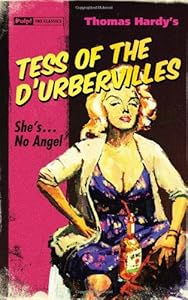
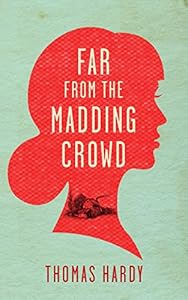
Tess of the d'Urbervilles: A Pure Woman Faithfully Presented is a novel by Thomas Hardy published by the British in 1891. Though now considered a major nineteenth-century English novel and possibly Hardy's fictional masterpiece, Tess of the d'Urbervilles received mixed reviews when it first appeared, in part because it challenged the sexual morals of late Victorian England. Summary : The novel is set in impoverished rural England, Thomas Hardy's fictional Wessex, during the Long Depression of the 1870s. Tess is the oldest child of John and Joan Durbeyfield, uneducated peasants. However, John is given the impression by Parson Tringham that he may have noble blood, as "Durbeyfield" is a corruption of "D'Urberville", the surname of an extinct noble Norman family. Knowledge of this immediately goes to John's head. That same day, Tess participates in the village May Dance, where she meets Angel Clare, youngest son of Reverend James Clare, who is on a walking tour with his two brothers. He stops to join the dance and partners several other girls. Angel notices Tess too late to dance with her, as he is already late for a promised meeting with his brothers. Tess feels slighted. Tess's father gets too drunk to drive to the market that night, so Tess undertakes the journey herself. However, she falls asleep at the reins, and the family's only horse encounters a speeding wagon and is fatally wounded. Tess feels so guilty over the horse's death and the economic consequences for the family that she agrees, against her better judgement, to visit Mrs d'Urberville, a rich widow who lives in a rural mansion near the town of Trantridge, and "claim kin". She is unaware that, in reality, Mrs d'Urberville's husband Simon Stoke adopted the surname even though he was unrelated to the real d'Urbervilles. Tess does not succeed in meeting Mrs d'Urberville, but chances to meet her libertine son, Alec, who takes a fancy to Tess and secures her a position as poultry keeper on the estate. Although Tess tells them about her fear that he might try to seduce her, her parents encourage her to accept the job, secretly hoping that Alec might marry her. Extrait : On an evening in the latter part of May a middle-aged man was walking homeward from Shaston to the village of Marlott, in the adjoining Vale of Blakemore, or Blackmoor. The pair of legs that carried him were rickety, and there was a bias in his gait which inclined him somewhat to the left of a straight line. He occasionally gave a smart nod, as if in confirmation of some opinion, though he was not thinking of anything in particular. An empty egg-basket was slung upon his arm, the nap of his hat was ruffled, a patch being quite worn away at its brim where his thumb came in taking it off. Presently he was met by an elderly parson astride on a gray mare, who, as he rode, hummed a wandering tune. 'Good night t'ee,' said the man with the basket. 'Good night, Sir John,' said the parson. The pedestrian, after another pace or two, halted, and turned round. 'Now, sir, begging your pardon; we met last market-day on this road about this time, and I said 'Good night,' and you made reply 'Good night, Sir John,' as now.' Biography : Thomas Hardy (1840-1928) was an English novelist and poet. A Victorian realist in the tradition of George Eliot, he was influenced both in his novels and in his poetry by Romanticism, especially William Wordsworth.[1] He was highly critical of much in Victorian society, especially on the declining status of rural people in Britain, such as those from his native South West England. While Hardy wrote poetry throughout his life and regarded himself primarily as a poet, his first collection was not published until 1898. Initially, therefore, he gained fame as the author of such novels as Far from the Madding Crowd (1874) , The Mayor of Casterbridge (1886) , Tess of the d'Urbervilles...